Skip to main content
Physics with Calculus
My Course
Learn
Exam Prep
AI Tutor
Study Guides
Textbook Solutions
Flashcards
Explore
Try the app
My Course
Learn
Exam Prep
AI Tutor
Study Guides
Textbook Solutions
Flashcards
Explore
Try the app
Back
Introduction to Vectors definitions
2 students found this helpful
You can tap to flip the card.
Vector
You can tap to flip the card.
👆
Vector
A quantity with both magnitude and direction, represented as an arrow in diagrams.
Track progress
Control buttons has been changed to "navigation" mode.
1/12
Related flashcards
Related practice
Recommended videos
Introduction to Vectors quiz #1
Introduction to Vectors
17 Terms
Introduction to Vectors
3. Vectors
1 problem
Topic
Emilee
Adding Vectors Graphically
3. Vectors
1 problem
Topic
Patrick
3. Vectors - Part 1 of 2
4 topics
9 problems
Chapter
Patrick
3. Vectors - Part 2 of 2
5 topics
13 problems
Chapter
Patrick
Guided course
05:06
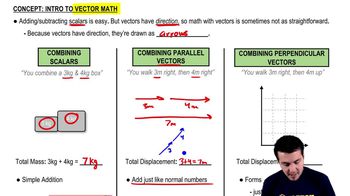
Introduction to Vector Math
21767
views
599
rank
7
comments
Terms in this set (12)
Hide definitions
Vector
A quantity with both magnitude and direction, represented as an arrow in diagrams.
Scalar
A quantity with only magnitude, such as mass or temperature, without direction.
Displacement
The shortest path between the initial and final position, often calculated using vectors.
Parallel Vectors
Vectors that have the same or opposite direction, allowing for straightforward addition.
Perpendicular Vectors
Vectors at right angles to each other, requiring the Pythagorean Theorem for combination.
Pythagorean Theorem
A mathematical equation used to calculate the hypotenuse of a right triangle.
Hypotenuse
The longest side of a right triangle, opposite the right angle, representing resultant displacement.
Resultant Vector
The vector sum of two or more vectors, representing total displacement.
Antiparallel Vectors
Vectors that are parallel but in opposite directions, affecting displacement calculation.
Triangle
A geometric shape formed by vectors, used to visualize and calculate resultant displacement.
Magnitude
The size or length of a vector, representing its strength or extent.
Direction
The orientation of a vector in space, indicated by the arrow's direction.
 BackBack

 05:06
05:06