How fast are objects inside a moving car traveling relative to the ground?
Objects inside a moving car travel at the same velocity as the car relative to the ground, assuming they are stationary with respect to the car.
What is the velocity of a ball when it reaches its highest point in its trajectory?
At the highest point of its trajectory, the vertical component of the ball's velocity is zero, but the horizontal component remains unchanged if air resistance is neglected.
What is the velocity of a ball 1 second before it reaches its highest point during its upward motion?
The velocity 1 second before reaching the highest point consists of both vertical and horizontal components; the vertical component is positive and less than its initial value, while the horizontal component remains constant.
What is the value of the velocity of a ball when it reaches its maximum height?
At maximum height, the vertical component of velocity is zero, and the velocity equals the horizontal component.
How do you determine the speed of an object at a specific height above the ground in two-dimensional motion?
To determine the speed at a specific height, calculate the magnitude of the velocity vector at that point using the Pythagorean theorem: speed = sqrt(vx^2 + vy^2), where vx and vy are the velocity components.
How do you calculate the speed of a rock as it hits the bottom of a hole in two-dimensional motion?
Calculate the magnitude of the velocity vector at the moment the rock reaches the bottom using the Pythagorean theorem: speed = sqrt(vx^2 + vy^2), where vx and vy are the velocity components at that instant.
How do you determine the velocity of a bicyclist at a specific time, such as t = 10 s, in two-dimensional motion?
The velocity at t = 10 s is found by dividing the displacement vector from the starting point to the position at t = 10 s by the elapsed time, giving both magnitude and direction.
How do S-waves travel through the Earth's outer core in terms of speed?
S-waves do not travel through the Earth's outer core because it is liquid; S-waves require a solid medium.
In two-dimensional motion, where is the x-component of velocity negative?
The x-component of velocity is negative when the object is moving in the negative x-direction.
How does speed compare to the velocity of an object in two-dimensional motion?
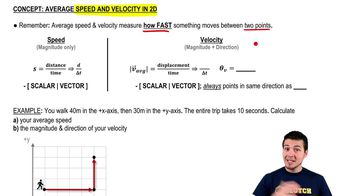
Speed is the magnitude of velocity and is a scalar, while velocity is a vector with both magnitude and direction.
How do you determine the initial speed of a ball kicked in two-dimensional motion?
The initial speed is the magnitude of the initial velocity vector, which can be calculated using the Pythagorean theorem if the components are known, or given directly.
What explains the difference between speed and velocity in two-dimensional motion?
Speed is a scalar quantity representing how fast an object moves, while velocity is a vector quantity that includes both speed and direction.
Can velocity be negative in two-dimensional motion?
Yes, velocity can be negative in a given direction, indicating motion opposite to the positive axis.
What is the difference between speed and velocity in two-dimensional motion?
Speed is the magnitude of motion (distance over time), while velocity includes both magnitude and direction (displacement over time).
How do speed and velocity differ in two-dimensional motion?
Speed is a scalar quantity (distance/time), while velocity is a vector quantity (displacement/time) with direction.
What is a difference between speed and velocity in two-dimensional motion?
Speed is scalar and measures how fast an object moves; velocity is vector and measures both how fast and in what direction.
How far will an aircraft travel in 7.5 minutes with a ground speed of 114 knots?
Distance = speed × time. Convert 7.5 minutes to hours (7.5/60), then multiply by 114 knots: Distance = 114 × (7.5/60) nautical miles.
How do you determine the speed of a proton at a specific point in two-dimensional motion?
The speed at a specific point is the magnitude of the velocity vector at that point, calculated as sqrt(vx^2 + vy^2).
How do you find the minimum and maximum velocities experienced by a rocket in two-dimensional motion?
Minimum and maximum velocities correspond to the smallest and largest magnitudes of the velocity vector during the rocket's trajectory, found by evaluating sqrt(vx^2 + vy^2) at relevant points.
If a string breaks suddenly while an object is in motion, how do you determine its speed at that instant?
The speed at the instant the string breaks is the magnitude of the velocity vector at that moment, calculated as sqrt(vx^2 + vy^2).
What is settling velocity in the context of two-dimensional motion?
Settling velocity is the constant speed at which a particle moves downward through a fluid under the influence of gravity, when the net force is zero.
How do velocity and turbulence vary at different locations in a fluid flow?
Velocity and turbulence are typically highest at the center of a flow and decrease toward the edges or boundaries.
How does velocity differ from speed in terms of indicating a particle's motion?
Velocity differs from speed in that velocity indicates both the magnitude and the direction of a particle's motion.
Unlike speed, what type of quantity is velocity?
Unlike speed, velocity is a vector quantity.
How do you find the resultant velocity vector when combining your swimming velocity and the current velocity in two dimensions?
Add the velocity vectors using vector addition: resultant velocity = your velocity vector + current velocity vector.
How do you convert a car's velocity from kilometers per hour to meters per second?
Multiply the velocity in km/h by (1000/3600) to convert to m/s.
How do you describe the velocity of an electron with a nonzero x-component in two-dimensional motion?
An electron with a nonzero x-component of velocity is moving in the x-direction, and its total velocity is a vector with both x and possibly y components.
If the test section area has an air speed of 10 m/s, how do you describe the velocity in two-dimensional motion?
The velocity is 10 m/s in the direction of airflow; if there are components in other directions, use vector addition to find the total velocity.
How do you determine the velocity vector of an airplane traveling at a given speed and direction in two dimensions?
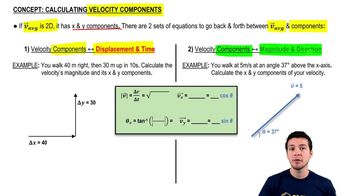
Express the velocity vector using its magnitude and direction, and calculate its components: vx = v × cos(theta), vy = v × sin(theta), where theta is the angle from a reference direction.
In two-dimensional motion, under what conditions is the x-component of velocity negative?
The x-component of velocity is negative when the object is moving in the negative x-direction, meaning its displacement along the x-axis decreases over time. Mathematically, this occurs when either the displacement in the x-direction (Δx) is negative or, if using velocity magnitude and direction, when cos(θ) is negative (i.e., θ is between 90° and 270° relative to the positive x-axis).
 Back
Back

 05:53
05:53