Velocity-Time Graphs & Acceleration quiz #1 Flashcards
Velocity-Time Graphs & Acceleration quiz #1
You can tap to flip the card.
Control buttons has been changed to "navigation" mode.
1/36
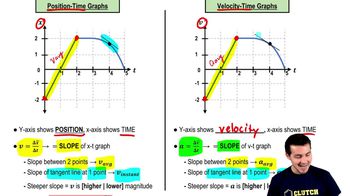
How do you determine the initial velocity of an object from a velocity-time graph?The initial velocity is the value of velocity at time t = 0 on the velocity-time graph.What information is needed to calculate speed and velocity?To calculate speed and velocity, you need the change in position (displacement) and the change in time.What can be said about a runner who is running at a constant velocity?A runner at constant velocity is moving in a straight line at a steady speed, with no acceleration.How can you identify a segment of a velocity-time graph that shows decreasing velocity?A segment with a downward slope (negative slope) on a velocity-time graph indicates decreasing velocity.How can you use a velocity versus time graph to estimate the acceleration of a ball?Estimate acceleration by calculating the slope of the velocity-time graph, which is the change in velocity divided by the change in time (Δv/Δt).How do you find the x-component of velocity from a position vs. time graph x(t)?The x-component of velocity is the slope of the x(t) position vs. time graph, calculated as Δx/Δt.How can you determine when two rockets have the same velocity using velocity-time graphs?The rockets have the same velocity at the time(s) when their velocity-time graphs intersect.What does a velocity-time graph look like for an object moving at constant speed?A velocity-time graph for constant speed is a horizontal line (constant value) above or below zero.How does a velocity-time graph show that a runner is moving fast?A runner is moving fast if the velocity value on the graph is large (far from zero), regardless of the slope.How do you identify segments of a velocity-time graph where velocity is constant?Velocity is constant in segments where the graph is a flat, horizontal line.What does it mean if a car has a negative displacement?Negative displacement means the car has moved in the direction opposite to the chosen positive direction.How can you tell if two cars ever have the same velocity at one instant of time using velocity-time graphs?If the velocity-time graphs of the two cars cross at any point, they have the same velocity at that instant.What feature on a speed-time graph indicates acceleration?Acceleration is shown by a sloped (non-horizontal) line on a speed-time graph.How does the acceleration graph of an object relate to its velocity-time graph?The acceleration graph shows the slope of the velocity-time graph at each point; constant slope yields constant acceleration.Why does a curve on a distance-time graph indicate acceleration?A curve on a distance-time graph means the slope (velocity) is changing, which indicates acceleration.What are the velocity and acceleration of a ball at the highest point in its path?At the highest point, the ball's velocity is zero, but its acceleration is not zero (it equals the acceleration due to gravity).How do you identify graphs showing an object traveling at a constant non-zero velocity?Graphs with a horizontal line at a non-zero value on a velocity-time graph show constant non-zero velocity.What does negative velocity look like on a velocity-time graph?Negative velocity is represented by a horizontal line below the time axis (y = negative value) on a velocity-time graph.How do you match a velocity vs. time graph to a given position vs. time graph?The velocity vs. time graph is the slope of the position vs. time graph at each point.What does a velocity-time graph look like when there is no acceleration?With no acceleration, the velocity-time graph is a horizontal line (constant velocity).On a velocity-time graph, what is measured along the y-axis?Velocity is measured along the y-axis of a velocity-time graph.How do you identify a graph showing negative acceleration?Negative acceleration is shown by a velocity-time graph with a downward (negative) slope.How do you identify a graph showing constant acceleration?Constant acceleration is shown by a straight line with a constant slope on a velocity-time graph.How do you identify acceleration on a graph?Acceleration is indicated by a sloped (non-horizontal) line on a velocity-time graph; the slope gives the acceleration value.How can you tell during which trial(s) an object's velocity is not constant?Velocity is not constant during trials where the velocity-time graph is not a horizontal line (i.e., the graph has a slope).How do you calculate the ratio of speed in two different sections of a motion graph?Calculate the speed in each section (distance/time), then divide the speed in section 3 by the speed in section 1 to get the ratio.How do you determine at which instant the speed of a car is greatest from a velocity-time graph?The speed is greatest at the point where the absolute value of velocity is highest on the graph.How do you identify two sentences describing the same velocity?Two sentences describe the same velocity if they refer to the same magnitude and direction of motion over the same time interval.How do you identify parts of a graph where an object is moving at a constant velocity?Parts of the graph with a flat, horizontal line on a velocity-time graph represent constant velocity.What does a flat horizontal line mean on a speed graph?A flat horizontal line on a speed graph means the object is moving at constant speed.What kind of gradient on a displacement-time graph shows constant velocity?A straight line with constant slope (gradient) on a displacement-time graph shows constant velocity.How can a table represent a car that increases and then decreases its speed?A table would show speed values that first increase over time, then decrease, reflecting acceleration followed by deceleration.What does the slope of a line on a velocity vs. time graph represent?The slope of a line on a velocity vs. time graph represents acceleration.How do you draw an object's velocity graph for time intervals separated by Δt = 2 s?Plot the velocity values at each 2-second interval on the velocity-time graph, connecting the points as appropriate.What does a velocity-versus-time graph for an object moving along the x-axis show?It shows how the object's velocity in the x-direction changes over time; the slope indicates acceleration.What does the slope at a point on a position-versus-time graph of an object represent?The slope at a point on a position-versus-time graph represents the object's instantaneous velocity at that time.