Vertical Equilibrium & The Normal Force definitions Flashcards
Vertical Equilibrium & The Normal Force definitions
You can tap to flip the card.
Control buttons has been changed to "navigation" mode.
1/15
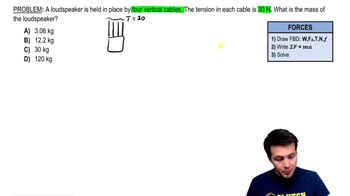
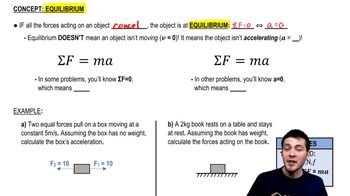
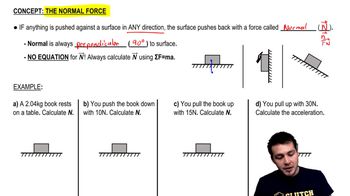
EquilibriumA state where the sum of all forces on an object is zero, resulting in zero acceleration.Normal ForceA force acting perpendicular to the surface of contact, adjusting to maintain equilibrium.AccelerationThe rate of change of velocity, which is zero in equilibrium scenarios.Weight ForceThe force due to gravity acting on an object, calculated as mass times gravitational acceleration.Free Body DiagramA visual representation of all forces acting on an object, used to solve equilibrium problems.Applied ForceAn external force acting on an object, which can affect the normal force and equilibrium.Gravitational PullThe force exerted by gravity on an object, contributing to its weight.Newton's Second LawA principle stating that force equals mass times acceleration (F=ma).Constant VelocityA state of motion where an object's speed and direction remain unchanged.Surface ContactThe interaction between two surfaces, where the normal force acts perpendicular.PerpendicularA direction at a 90-degree angle to a given surface, characteristic of the normal force.Force CancellationThe condition where opposing forces are equal, resulting in equilibrium.Net ForceThe overall force acting on an object, which is zero in equilibrium.MagnitudeThe size or amount of a force, often measured in newtons.Contact ForceA force that occurs at the point of contact between two objects, such as the normal force.