Skip to main content
Physics with Calculus
My Course
Learn
Exam Prep
AI Tutor
Study Guides
Textbook Solutions
Flashcards
Explore
Try the app
My Course
Learn
Exam Prep
AI Tutor
Study Guides
Textbook Solutions
Flashcards
Explore
Try the app
Back
Young's Double Slit Experiment definitions
You can tap to flip the card.
Diffraction
You can tap to flip the card.
👆
Diffraction
The bending of light waves around obstacles, leading to interference patterns.
Track progress
Control buttons has been changed to "navigation" mode.
1/15
Related flashcards
Related practice
Recommended videos
Young's Double Slit Experiment quiz #1
Young's Double Slit Experiment
10 Terms
Young's Double Slit Experiment
34. Wave Optics
7 problems
Topic
Emilee
Single Slit Diffraction
34. Wave Optics
7 problems
Topic
Patrick
34. Wave Optics
4 topics
8 problems
Chapter
Patrick
Guided course
12:00
Young's Double Slit Experiment
9508
views
110
rank
8
comments
Guided course
05:42
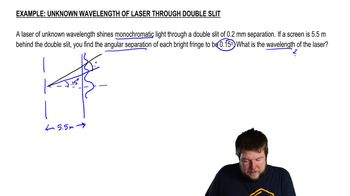
Unknown Wavelength of Laser through Double Slit
5641
views
101
rank
2
comments
Terms in this set (15)
Hide definitions
Diffraction
The bending of light waves around obstacles, leading to interference patterns.
Interference
The process where two or more light waves superpose to form a resultant wave.
Constructive Interference
Occurs when light waves combine to increase amplitude, creating bright fringes.
Destructive Interference
Occurs when light waves combine to decrease amplitude, creating dark fringes.
Fringe
A band of light or dark formed by interference of light waves.
Wavelength
The distance between successive peaks of a wave, denoted by lambda (λ).
Slit Separation
The distance between two slits in a double slit experiment, denoted by D.
Indexing Number
A number (m or n) used to identify the order of bright or dark fringes.
Central Bright Fringe
The brightest fringe located at the center of the diffraction pattern.
Angle of Diffraction
The angle at which light waves emerge from slits, forming interference patterns.
Isotropic
Having identical properties in all directions, as in light spreading from slits.
Amplitude
The height of a wave, determining its brightness in interference patterns.
Tangent
A trigonometric function used to calculate distances in diffraction problems.
Nanometer
A unit of length equal to one billionth of a meter, used to measure wavelengths.
Trigonometry
A branch of mathematics dealing with angles and distances, used in diffraction analysis.
 BackBack


 12:00
12:00