What pattern is observed when a laser shines on a pair of vertical slits in Young's double slit experiment, and what causes this pattern?
When a laser shines on a pair of vertical slits in Young's double slit experiment, a pattern of alternating bright and dark fringes (a diffraction pattern) is observed on a screen. This pattern is caused by the constructive and destructive interference of light waves emerging from the two slits at various angles.
What is the main reason a single bright spot was initially expected in Young's double slit experiment before diffraction was understood?
It was expected because collimated light passing through the slits was thought to remain undisturbed and produce uniform brightness. The concept of diffraction, which causes light to spread and interfere, was not yet understood.
How does diffraction affect the light as it passes through each slit in Young's double slit experiment?
Diffraction causes the collimated light to spread out isotropically, meaning in all directions, after passing through each slit. This spreading enables the light waves to overlap and interfere on the screen.
What is the technical term for the alternating bright and dark spots observed on the screen in Young's double slit experiment?
The technical term for these spots is 'fringes.' Bright spots are called bright fringes, and dark spots are called dark fringes.
What determines whether a bright or dark fringe appears at a particular location on the screen in Young's double slit experiment?
A bright fringe appears where the light waves interfere constructively, and a dark fringe appears where they interfere destructively. The type of interference depends on the path difference between the waves from the two slits.
In the context of the experiment, what does the variable 'd' represent in the formulas for fringe positions?
'd' represents the separation distance between the two slits. It is a key parameter in determining the angles at which bright and dark fringes appear.
Why does the calculation for the angle of a bright fringe in Young's double slit experiment typically yield a very small value?
The angle is small because the wavelength of light is much smaller than the slit separation. The theoretical derivation of the formula assumes these small angles for accuracy.
How is the index number 'm' assigned to the bright fringes in Young's double slit experiment?
'm' starts at 0 for the central bright fringe and increases by 1 for each subsequent bright fringe. The first bright fringe off-center is m = 1, the second is m = 2, and so on.
What trigonometric function is used to relate the distance from the central fringe to a bright fringe on the screen, and what are its components?
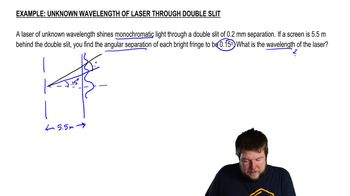
The tangent function is used, relating the angle to the ratio of the distance from the central fringe (opposite side) to the distance from the slits to the screen (adjacent side). This allows calculation of the fringe's position on the screen.
Why is it important to memorize the standard diagram used in analyzing double slit problems?
The standard diagram helps visualize the geometry and relationships between the slits, screen, and fringes. It is essential for correctly applying the formulas and solving double slit problems.