 Back
chapt 15
 04:54

Terms in this set (20)
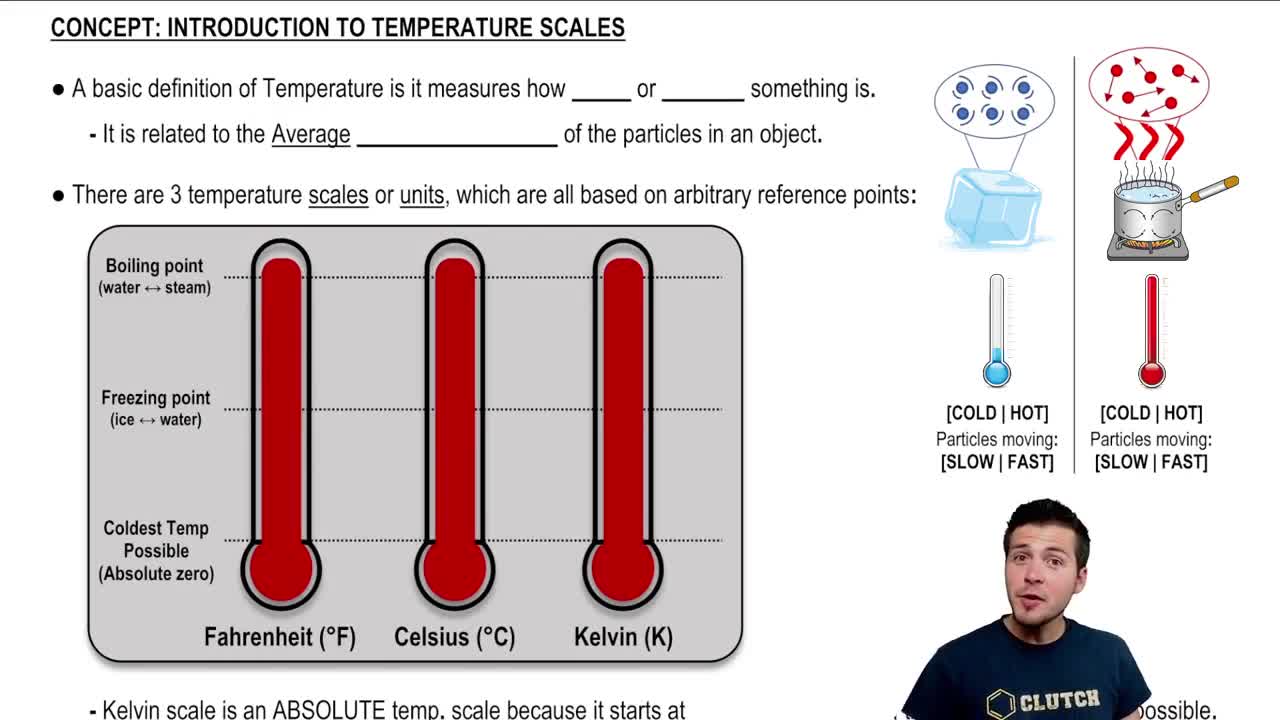
Temperature is a quantity that corresponds to the warmth or coldness of an object and is proportional to the average translational kinetic energy of molecules.
Temperature is measured by a thermometer, which can be a liquid thermometer (mercury or alcohol) or an infrared thermometer sensing IR radiation.
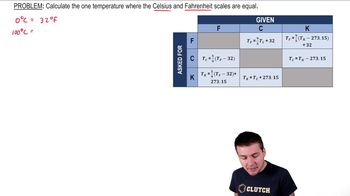
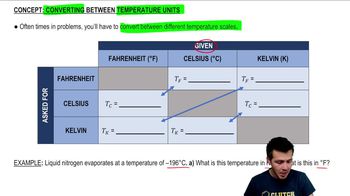
Celsius (0°C freezing, 100°C boiling), Fahrenheit (32°F freezing, 212°F boiling), and Kelvin (0 K absolute zero, same interval as Celsius).
Heat is internal energy transferred from one object to another due to a temperature difference, flowing from higher to lower temperature until equilibrium.
Specific heat capacity is the quantity of heat required to change the temperature of a unit mass of a substance by 1°C.
Substances with higher specific heat capacity, like water, take longer to heat than those with lower capacity, like iron.
Water molecules absorb energy by increasing molecular rotation and vibration without raising temperature much, storing more energy than most substances.
Oceans with high specific heat moderate climate by storing and releasing heat slowly, affecting coastal temperatures and wind patterns.
Thermal expansion is the increase in volume of a substance as its temperature rises due to molecules moving farther apart.
Railroad tracks expanding and buckling in summer, metal lids loosening on jars when heated, and expansion joints in bridges.
A strip of two metals with different expansion rates that bends when heated, used in thermostats and switches.
Because lines expand and lengthen in heat, sag prevents snapping when they contract in cold weather.
Liquids generally expand more than solids when heated, e.g., gasoline expanding in a car's tank on a hot day.
Water expands about 9% when it freezes due to open-structured ice crystals, making ice less dense and able to float.
Water contracts as it warms from 0°C to 4°C because ice crystals collapse, then expands above 4°C due to molecular motion.
Ice is less dense than liquid water because its crystal structure occupies more volume.
The same heat added to a smaller amount of water causes a larger temperature increase than in a larger amount.
4.18 joules of heat are required to raise the temperature of 1 gram of water by 1°C.
1 calorie equals 4.18 joules of energy.
A food Calorie is 1000 calories, the heat needed to raise 1 kg of water by 1°C.