 Back
chapt 6
 05:17

Terms in this set (20)
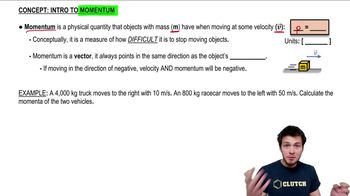
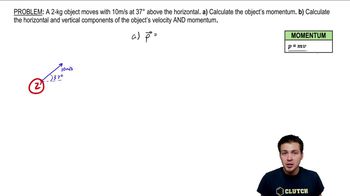
Momentum is a property of moving objects, defined as the product of an object's mass and velocity.
Momentum is calculated by the formula \(p = mv\), where m is mass and v is velocity.
The momentum doubles because momentum is directly proportional to velocity.
Impulse is the product of force and the time interval over which it acts, expressed as \(Impulse = Ft\).
Impulse changes momentum; the greater the impulse, the greater the change in momentum.
Because the haystack increases the time over which momentum changes, reducing the force experienced by the car.
Increasing contact time reduces the average force exerted, resulting in a smaller force for the same change in momentum.
In the absence of external forces, the total momentum of a system remains constant.
The cannonball gains forward momentum, and the cannon recoils with equal momentum in the opposite direction.
An elastic collision is one where colliding objects rebound without lasting deformation or heat generation.
An inelastic collision results in deformation and/or heat generation during the collision.
The speed of the coupled cars is half the initial speed of the moving car due to doubled mass and conserved momentum.
Use vector addition, such as creating a parallelogram of the momentum vectors, to find the combined momentum.
The impulse is doubled because impulse equals force multiplied by time.
Because the force acts over a longer time, producing a greater impulse and thus greater momentum.
A short time interval produces a large force for the same change in momentum.
Because the momentum changes direction, requiring a greater impulse than simply stopping the object.
Impulse equals the change in momentum, expressed as \(Ft = \Delta mv\).
Bending knees increases the time over which momentum decreases, reducing the force exerted by the ground.
Internal forces cancel out, so they do not change the total momentum of the system.