Skip to main content
Physics with Calculus
My Course
Learn
Exam Prep
AI Tutor
Study Guides
Textbook Solutions
Flashcards
Explore
Try the app
My Course
Learn
Exam Prep
AI Tutor
Study Guides
Textbook Solutions
Flashcards
Explore
Try the app
Back
chapt 7
You can tap to flip the card.
What does the Work-Energy Theorem state?
You can tap to flip the card.
👆
What does the Work-Energy Theorem state?
Any change in kinetic energy is the result of work done on the object, expressed as \(W=\Delta KE\).
Track progress
Control buttons has been changed to "navigation" mode.
1/22
Recommended videos
Guided course
04:41
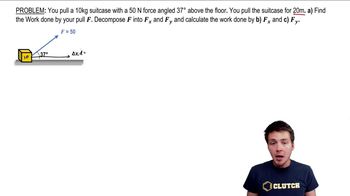
Work by a 2D Push/Pull
17142
views
464
rank
4
comments
Guided course
02:30
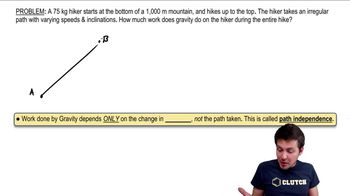
Work Done on Curvy (Not straight) Paths
12586
views
382
rank
4
comments
Guided course
04:29
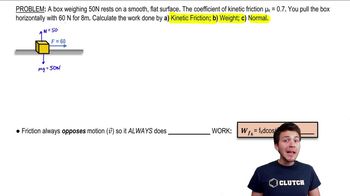
Work Done By Friction
16747
views
398
rank
6
comments
Terms in this set (22)
Hide definitions
What does the Work-Energy Theorem state?
Any change in kinetic energy is the result of work done on the object, expressed as \(W=\Delta KE\).
How does work relate to an object's speed when starting from rest?
If an object obtains twice the speed, it has been subject to four times the work.
What is the formula for work done by a force?
Work is the product of force and distance moved in the direction of the force: \(W=Fd\).
What is the unit of work and its equivalent in base units?
The unit of work is the joule (J), where 1 J = 1 newton × 1 meter (1 N·m).
What is the law of conservation of energy?
Energy cannot be created or destroyed; it can only be transformed from one form to another, with the total energy remaining constant.
What are the two main forms of mechanical energy?
Mechanical energy consists of potential energy (due to position) and kinetic energy (due to motion).
How is gravitational potential energy calculated?
Potential energy is given by \(PE=mgh\), where m is mass, g is gravitational acceleration, and h is height.
What is kinetic energy and its formula?
Kinetic energy is the energy of motion, calculated as \(KE=\frac{1}{2}mv^2\).
How does kinetic energy change if speed doubles?
If speed doubles, kinetic energy increases by a factor of four.
What is the difference between momentum and kinetic energy?
Momentum is a vector quantity depending linearly on velocity, while kinetic energy is a scalar quantity depending on the square of velocity.
What is power in physics?
Power is the rate at which work is done, calculated as work done divided by time interval.
What is the unit of power and its relation to work and time?
Power is measured in watts (W), where 1 W = 1 joule per second (1 J/s).
What is the principle of a machine regarding work input and output?
An ideal machine conserves energy, so work input equals work output: \(F_{in}d_{in} = F_{out}d_{out}\).
What does a lever do as a simple machine?
A lever rotates on a fulcrum and allows a small force over a large distance to produce a large force over a short distance.
How does a pulley system affect force and distance?
A pulley changes the direction of the input force and can multiply force when arranged as a block and tackle.
How is efficiency of a machine defined?
Efficiency is the percentage of work input converted into useful work output, calculated as useful energy output divided by total energy input.
What does it mean if a machine is 30% efficient?
It converts 30% of the energy input into useful work, with 70% lost as waste energy.
What is recycled energy?
Recycled energy is the reuse of energy that would otherwise be wasted, such as using heat from power plants to warm buildings.
How does the human body obtain energy?
The body uses energy stored in food hydrocarbons, which release energy when reacting with oxygen.
What are some renewable sources of energy from the Sun?
Sunlight evaporates water for hydroelectric power, photovoltaic cells convert sunlight to electricity, and wind power drives turbines.
How does a fuel cell produce electricity?
Hydrogen and oxygen are compressed at electrodes, producing electric current and water as a byproduct.
What is geothermal energy and how is it used?
Geothermal energy is heat stored underground, used to produce steam that drives turbines for electricity generation.
 BackBack
 04:41