 Back
chapt 9
 01:54

Terms in this set (21)
Newtonian synthesis is the idea that the same set of laws apply to both celestial and terrestrial objects, unifying earthly and heavenly laws.
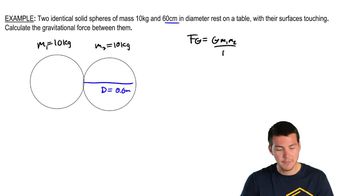
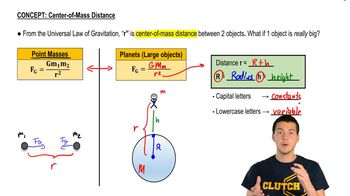
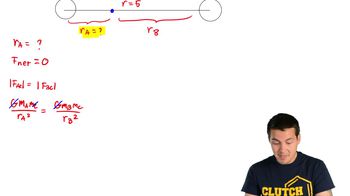
Every body attracts every other body with a force directly proportional to the product of their masses and inversely proportional to the square of the distance between them.
G is the constant that links gravitational force with mass and distance, with value approximately \(6.67 \times 10^{-11}\) Nm²/kg².
The gravitational force magnitude varies inversely with the square of the distance between two masses, meaning force decreases rapidly as distance increases.
If both masses are doubled, the gravitational force between them quadruples.
If one mass is doubled while the other remains constant, the gravitational force between them doubles.
When accelerating upward, your apparent weight is greater than your rest weight due to increased support force.
When accelerating downward, your apparent weight is less than your rest weight due to reduced support force.
In free fall (cable breaks), your apparent weight is zero because there is no support force.
The scale shows the greatest weight when the elevator accelerates upward.
Ocean tides are caused by the gravitational attraction of the Moon and the Sun, creating unequal tugs that stretch Earth's oceans.
Spring tides occur during new or full Moon when the gravitational effects of the Moon and Sun add up, causing more pronounced tides.
Neap tides occur when the Moon is halfway between new and full, causing the Sun and Moon's gravitational effects to partly cancel, resulting in less pronounced tides.
A gravitational field is an alteration of space around a mass, representing the force that mass exerts on other masses without contact.
Field lines radiate inward toward Earth, indicating the force is always attractive and stronger closer to Earth where lines crowd.
Inside a planet, gravitational field decreases to zero at the center because pulls from mass above and below partially cancel.
Acceleration toward Earth's center decreases with depth, reaching zero at the center, then reverses direction as you pass through.
Gravity is a warping of space-time by mass, analogous to a dent on a waterbed affecting the motion of other objects.
A black hole forms when a collapsing star's mass is concentrated in a small radius, creating a gravitational field so strong that nothing can escape.
If the Sun became a black hole without changing mass or distance, Earth's orbit would remain unchanged because gravitational force depends on mass and distance.
A wormhole is a theoretical distortion of space-time that connects different parts of the universe or different universes, but none have been discovered.