Skip to main content
Physics with Calculus
My Course
Learn
Exam Prep
AI Tutor
Study Guides
Textbook Solutions
Flashcards
Explore
Try the app
My Course
Learn
Exam Prep
AI Tutor
Study Guides
Textbook Solutions
Flashcards
Explore
Try the app
Back
Concepts of Motion - Physics
You can tap to flip the card.
Which car is moving slower in a motion diagram with equal time intervals?
You can tap to flip the card.
👆
Which car is moving slower in a motion diagram with equal time intervals?
The car with smaller distances between positions in the motion diagram is moving slower.
Track progress
Control buttons has been changed to "navigation" mode.
1/20
Recommended videos
Guided course
06:13
Displacement vs. Distance
22281
views
581
rank
7
comments
Guided course
04:06
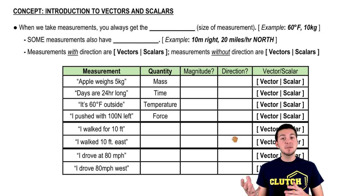
Introduction to Vectors and Scalars
31138
views
1090
rank
1
comments
Terms in this set (20)
Hide definitions
Which car is moving slower in a motion diagram with equal time intervals?
The car with smaller distances between positions in the motion diagram is moving slower.
Identify the motion types: dust particle settling, ball dropped, and descending rocket slowing down.
Dust particle settles at constant speed, ball dropped accelerates downward, rocket slows down for soft landing.
How do you find the vector sum of two vectors P and Q?
Add vectors head-to-tail; the resultant vector points from the tail of the first to the head of the second.
How do you find the vector difference P - Q?
Subtract vector Q from P by adding P to the negative of Q (reverse Q's direction).
What happens to the velocity vector of a particle accelerating from point 1 to 2 and moving to point 3?
The velocity vector changes direction and magnitude according to acceleration; it points along the new direction of motion.
Describe the motion diagram of a cyclist stopping from 20 mph in 4 s and then accelerating to 15 mph in 6 s.
The motion diagram shows decreasing spacing between points during stopping, then increasing spacing during acceleration.
At the highest point of a ball tossed straight up, what is the direction of its acceleration vector?
The acceleration vector points downward due to gravity, even at the highest point.
If a particle is slowing down and its position x is positive, what is the sign of its velocity v_x?
Velocity v_x is positive if the particle is slowing down while position x is positive.
For a particle slowing down, what is the sign of its acceleration a_x?
Acceleration a_x is negative if the particle is slowing down while moving in the positive direction.
How to interpret a graph showing an object moving along a straight line with stops and starts?
The graph likely represents a car that drives and stops repeatedly.
How to rank numbers by the number of significant figures: 8200, 0.0052, 0.430, 4.321 × 10⁻¹⁰?
4.321 × 10⁻¹⁰ has 4 sig figs, 0.430 has 3, 0.0052 has 2, and 8200 is ambiguous but often 2.
What does a motion diagram with arrows decreasing in length indicate?
It indicates the object is slowing down, as velocity magnitude decreases.
How does acceleration relate to velocity when an object slows down?
Acceleration vector points opposite to the velocity vector when slowing down.
What is the significance of the acceleration vector at the top of a vertical motion?
Acceleration is not zero at the top; it points downward due to gravity.
How to find acceleration while an object is going up or down in vertical motion?
Acceleration vector points downward both going up and coming down due to gravity.
What does a motion diagram with equal spacing between points indicate?
It indicates constant velocity motion.
How to represent velocity and acceleration vectors in a slowing particle moving along x-axis?
Velocity vector points in direction of motion; acceleration vector points opposite when slowing.
What does a motion diagram with arrows pointing opposite to velocity indicate?
It indicates deceleration or negative acceleration.
How to interpret vectors P and Q when P points diagonally down and Q points left?
Vector addition P + Q results in a vector combining both directions; subtraction reverses Q.
What is the effect of acceleration on velocity vectors between points in motion?
Acceleration changes the velocity vector's magnitude and/or direction between points.
 BackBack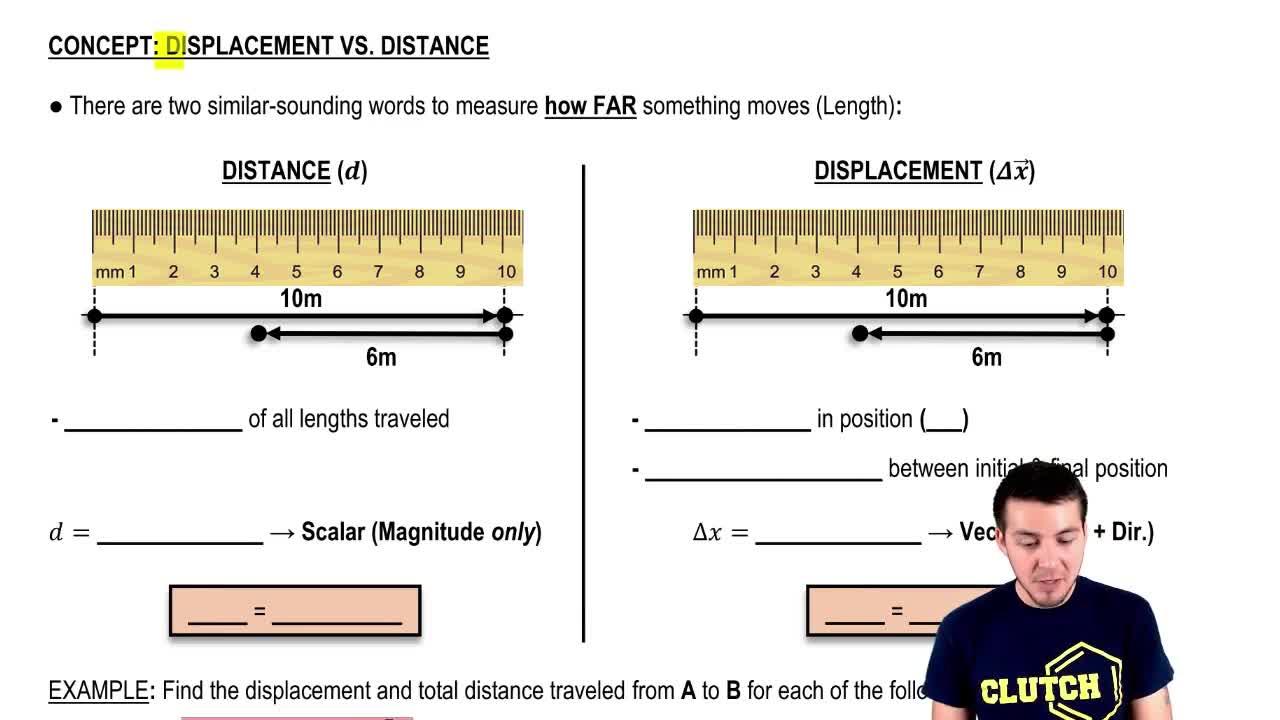
 06:13
06:13