 Back
Kinematics and Motion in One Dimension
 06:13

Terms in this set (20)
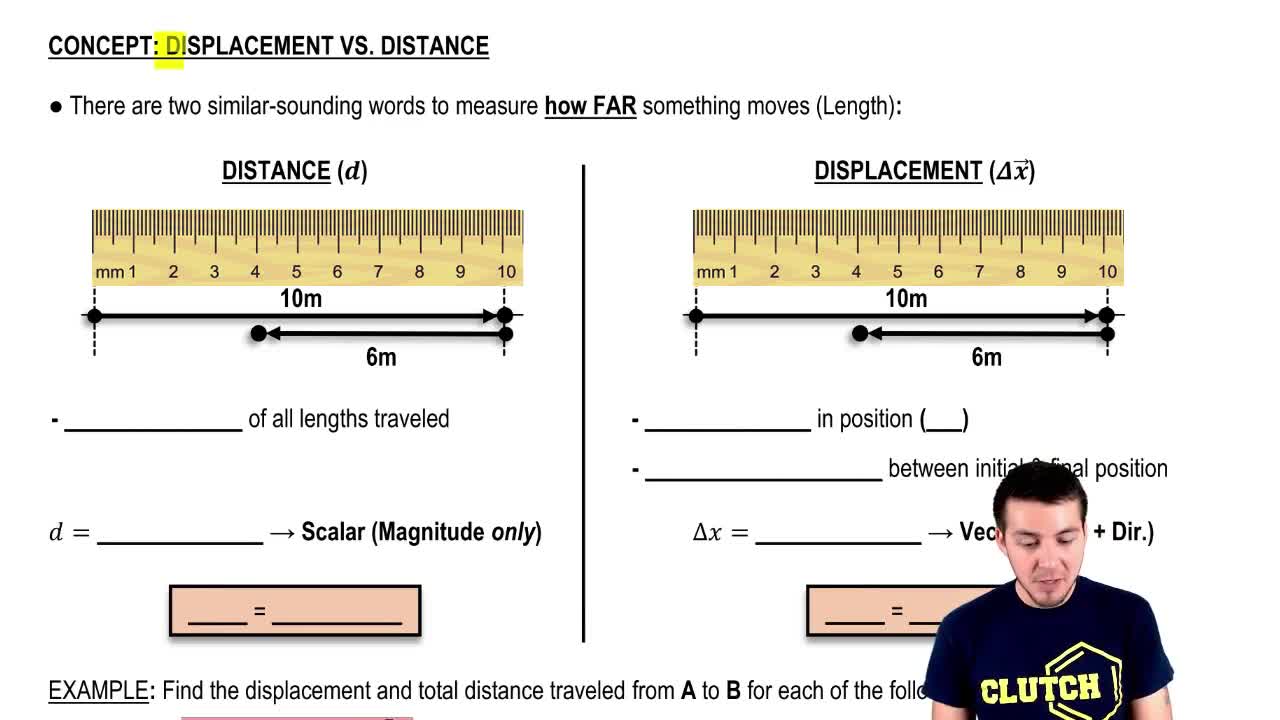
Displacement is the change in the particle's coordinate, given by \(\Delta x = x_2 - x_1\).
Average velocity is the displacement divided by the time interval: \(v_{av-x} = \frac{\Delta x}{\Delta t}\).
If x is positive and increasing, velocity is positive; if x is positive and decreasing, velocity is negative; if x is negative and increasing, velocity is positive; if x is negative and decreasing, velocity is negative.
Instantaneous velocity is the velocity at a specific time, calculated as \(v_x = \lim_{\Delta t \to 0} \frac{\Delta x}{\Delta t} = \frac{dx}{dt}\).
Instantaneous velocity equals the slope of the tangent to the position-time curve at a given point.
Average speed is the total distance divided by time, while magnitude of average velocity is displacement divided by time; they are not always equal.
Average acceleration is the change in velocity divided by the time interval: \(a_{av-x} = \frac{\Delta v_x}{\Delta t}\).
Instantaneous acceleration is the rate of change of velocity at a specific time: \(a_x = \lim_{\Delta t \to 0} \frac{\Delta v_x}{\Delta t} = \frac{dv_x}{dt}\).
If velocity is positive and increasing, acceleration is positive; if velocity is positive and decreasing, acceleration is negative; if velocity is negative and increasing, acceleration is positive; if velocity is negative and decreasing, acceleration is negative.
Acceleration is constant and the velocity-time graph is a straight line with slope equal to acceleration.
It is a horizontal line with slope zero, indicating constant acceleration.
Equations include: \(v_x = v_{0x} + a_x t\), \(x = x_0 + v_{0x} t + \frac{1}{2} a_x t^2\), \(v_x^2 = v_{0x}^2 + 2 a_x (x - x_0)\), and \(x - x_0 = \frac{1}{2} (v_{0x} + v_x) t\).
Free fall is motion under the influence of gravity alone, with constant acceleration \(g = 9.8\, m/s^2\) downward.
Velocity decreases until zero at the highest point, then increases downward; acceleration remains constant downward.
The acceleration is constant and equal to \(g = 9.8\, m/s^2\) downward.
Velocity is the integral of acceleration over time: \(v_x = v_{0x} + \int a_x dt\).
Position is the integral of velocity over time: \(x = x_0 + \int v_x dt\).
The area under the acceleration-time graph equals the change in velocity over that time interval.
The slope of the position-time graph at any point equals the instantaneous velocity at that point.
The curvature indicates acceleration; positive curvature means positive acceleration, negative curvature means negative acceleration.