 Back
Newton's Second Law and Forces in Motion - Physics with Calculus
 04:46

Terms in this set (20)
Mass is a scalar quantity; it has magnitude only and no direction.
Weight is calculated as weight = mass × gravity, where gravity \(g=9.81\,m/s^2\).
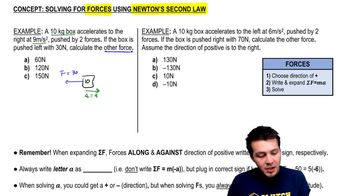
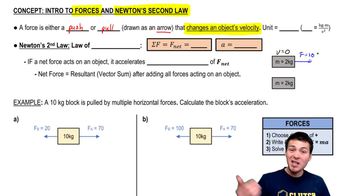
Force = mass × acceleration, expressed as \(F=ma\).
Acceleration increases when unbalanced forces act in the same direction as motion.
Acceleration decreases when unbalanced forces act opposite to the direction of motion.
If mass doubles, the force must also double to keep the same acceleration, according to \(F=ma\).
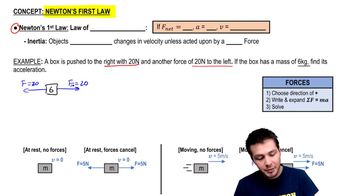
Inertia is the resistance to changes in motion and is directly related to mass; more mass means more inertia.
Terminal velocity occurs when air resistance equals weight, causing acceleration to become zero.
At terminal velocity, air resistance force equals weight, so the net force is zero.
Acceleration is \(a=\frac{mg - R}{m}\), where R is air resistance.
Because air resistance opposes gravity, reducing the net force and thus lowering acceleration.
Static friction (starting motion) is greater than sliding friction (maintaining motion).
Static friction must be overcome to start motion, requiring more force than sliding friction, which acts during motion.
Weight = 2 kg × 9.81 m/s² = 19.62 N.
Force = 5 kg × 3 m/s² = 15 N.
Force = 2 kg × 10 m/s² = 20 N.
The 5 kg rock resists acceleration more due to its greater mass and inertia.
Weight changes because gravity differs, but mass remains constant as it is an intrinsic property.
Acceleration = (2 kg × 9.81 m/s² - 10 N) / 2 kg = 4.81 m/s².
No, 10 kg is a scalar quantity; it has magnitude only and no direction.