Skip to main content
Physics with Calculus
My Course
Learn
Exam Prep
AI Tutor
Study Guides
Textbook Solutions
Flashcards
Explore
Try the app
My Course
Learn
Exam Prep
AI Tutor
Study Guides
Textbook Solutions
Flashcards
Explore
Try the app
Back
Physics Chapter 21: Electric Charge and Fields
You can tap to flip the card.
What letter represents electric charge?
You can tap to flip the card.
👆
What letter represents electric charge?
Electric charge is represented by the letter \(q\) or \(Q\).
Track progress
Control buttons has been changed to "navigation" mode.
1/21
Recommended videos
Guided course
01:06
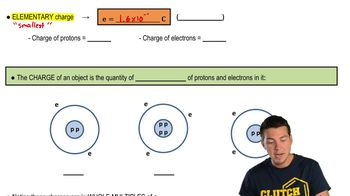
Charge of Atom
19133
views
546
rank
Guided course
05:37
Electric Charge
30611
views
1005
rank
4
comments
Guided course
04:32
Electrons In Water (Using Density)
16242
views
337
rank
17
comments
Terms in this set (21)
Hide definitions
What letter represents electric charge?
Electric charge is represented by the letter \(q\) or \(Q\).
What is the SI unit of electric charge?
The SI unit of electric charge is the
coulomb (C)
.
What letter represents the number of particles?
The number of particles is represented by the letter \(N\) and is unitless.
What letter represents the number of moles?
The number of moles is represented by the letter \(n\) and measured in
moles (mol)
.
What letter represents the electric field?
The electric field is represented by the letter \(E\) and measured in
newtons per coulomb (N/C)
.
What letter represents the electric dipole moment?
The electric dipole moment is represented by the letter \(p\) and measured in
coulomb-meters (C⋅m)
.
What is the value and unit of the elementary charge?
The elementary charge is \(e=1.602\times10^{-19}\)
coulombs (C)
.
What is the mass of an electron?
The mass of an electron is \(m_e=9.11\times10^{-31}\)
kilograms (kg)
.
What is the mass of a proton?
The mass of a proton is \(m_p=1.67\times10^{-27}\)
kilograms (kg)
.
What is the electrostatic constant and its unit?
The electrostatic constant is \(k=8.99\times10^{9}\) and measured in
newton meter squared per coulomb squared (N⋅m²/C²)
.
What is the relationship between the electrostatic constant \(k\) and permittivity of free space \(\varepsilon_0\)?
The relationship is \(k=\frac{1}{4\pi\varepsilon_0}\).
Write the equation that shows charge is quantized.
Charge quantization is expressed as \(Q_{tot}=\pm N e\).
Write the equation that shows mass is transferred when charge is transferred.
Mass transferred is given by \(M_{transferred}=N m_e\).
State Coulomb's Law equation.
Coulomb's Law is \(F_q=k \frac{|q_1 q_2|}{r^2}\).
How do like and unlike charges behave toward each other?
Like charges repel
and
unlike charges attract
.
Write the equation relating electrostatic force to electric field.
The relation is \(F=qE\).
How do positive and negative charges behave in an electric field?
Positive charges experience force
in the direction of the field
, negative charges experience force
opposite to the field direction
.
Write the equation for the electric field due to a point charge.
Electric field at distance r is \(E(r)=k \frac{|q|}{r^2}\).
Describe the direction of an electric field.
Electric field points
away from positive charges
and
toward negative charges
.
Write the equation defining the electric dipole moment.
Electric dipole moment is defined as \(p=qd\), where q is charge and d is separation distance.
How is the direction of the electric dipole moment defined?
It points from the
negative point charge to the positive point charge
.
 BackBack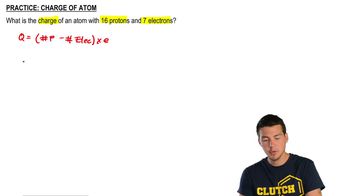
 01:06
01:06