Skip to main content
Physics with Calculus
My Course
Learn
Exam Prep
AI Tutor
Study Guides
Textbook Solutions
Flashcards
Explore
Try the app
My Course
Learn
Exam Prep
AI Tutor
Study Guides
Textbook Solutions
Flashcards
Explore
Try the app
Back
Physics: Electric Circuits and Capacitors
You can tap to flip the card.
Equivalent resistance of resistors in series
You can tap to flip the card.
👆
Equivalent resistance of resistors in series
The equivalent resistance is the sum: \(R_{eq}=R_1+R_2+R_3+\dots\).
Track progress
Control buttons has been changed to "navigation" mode.
1/20
Recommended videos
Guided course
02:33
Current Through Unknown Resistor
8528
views
169
rank
Guided course
03:07
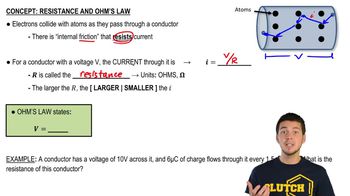
Resistance and Ohm's Law
13526
views
300
rank
1
comments
Guided course
05:25
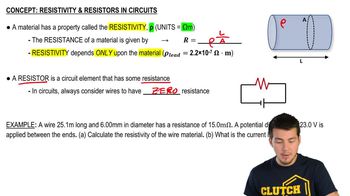
Resistivity & Resistors in Circuits
11507
views
247
rank
4
comments
Terms in this set (20)
Hide definitions
Equivalent resistance of resistors in series
The equivalent resistance is the sum: \(R_{eq}=R_1+R_2+R_3+\dots\).
Current in resistors connected in series
The current is the same through all resistors: \(I_{tot}=I_1=I_2=I_3=\dots\).
Voltage drops across resistors in series
The total voltage drop is the sum of individual drops: \(V_{tot}=V_1+V_2+V_3+\dots\).
Equivalent resistance of resistors in parallel
The reciprocal of equivalent resistance is the sum of reciprocals: \(\frac{1}{R_{eq}}=\frac{1}{R_1}+\frac{1}{R_2}+\frac{1}{R_3}+\dots\).
Current in resistors connected in parallel
The total current is the sum of currents through each resistor: \(I_{tot}=I_1+I_2+I_3+\dots\).
Voltage across resistors in parallel
The voltage across each resistor is the same: \(V_{tot}=V_1=V_2=V_3=\dots\).
Kirchhoff's Junction Rule
The sum of currents entering a junction equals zero: \(\sum I_i=0\) (currents into junction positive, out negative).
Kirchhoff's Loop Rule
The sum of potential changes around any closed loop is zero: \(\sum \Delta V_i=0\).
Potential change moving in direction of current over resistor
Potential drop is negative: \(\Delta V = -RI\).
Potential change moving against direction of current over resistor
Potential change is positive: \(\Delta V = +RI\).
Potential change moving from negative to positive terminal of battery
Potential change is positive: \(\Delta V = +E\).
Potential change moving from positive to negative terminal of battery
Potential change is negative: \(\Delta V = -E\).
Time constant of an RC circuit
The time constant is \(\tau=RC\), representing the characteristic time for charging or discharging.
Charging current in an RC circuit
Current decreases exponentially: \(i(t)=I_0 e^{-t/\tau}\), where \(I_0=\frac{\varepsilon}{R}\).
Charging charge on capacitor in RC circuit
Charge increases as: \(q(t)=Q_0(1-e^{-t/\tau})\), with \(Q_0=\varepsilon C\).
Discharging charge on capacitor in RC circuit
Charge decreases exponentially: \(q(t)=Q_0 e^{-t/\tau}\).
Definition of capacitance
Capacitance relates charge and voltage: \(Q=VC\).
Equivalent capacitance of capacitors in series
Reciprocal of equivalent capacitance is sum of reciprocals: \(\frac{1}{C_{eq}}=\frac{1}{C_1}+\frac{1}{C_2}+\frac{1}{C_3}+\dots\).
Equivalent capacitance of capacitors in parallel
Equivalent capacitance is sum: \(C_{eq}=C_1+C_2+C_3+\dots\).
Potential energy stored in a capacitor
Energy stored is \(U_C=\frac{1}{2}CV^2 = \frac{Q^2}{2C} = \frac{1}{2}QV\).
 BackBack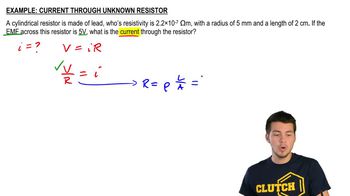
 02:33
02:33