Skip to main content
Physics with Calculus
My Course
Learn
Exam Prep
AI Tutor
Study Guides
Textbook Solutions
Flashcards
Explore
Try the app
My Course
Learn
Exam Prep
AI Tutor
Study Guides
Textbook Solutions
Flashcards
Explore
Try the app
Back
Physics Final Exam Practice Problems
You can tap to flip the card.
Identify the vectors among acceleration, velocity, speed, displacement, and mass.
You can tap to flip the card.
👆
Identify the vectors among acceleration, velocity, speed, displacement, and mass.
Acceleration
,
velocity
, and
displacement
are vectors;
speed
and
mass
are scalars.
Track progress
Control buttons has been changed to "navigation" mode.
1/20
Recommended videos
Guided course
06:13
Displacement vs. Distance
22306
views
584
rank
7
comments
Guided course
04:06
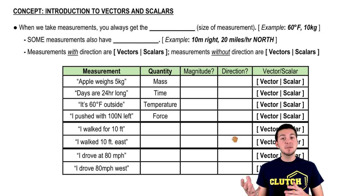
Introduction to Vectors and Scalars
31172
views
1096
rank
1
comments
Terms in this set (20)
Hide definitions
Identify the vectors among acceleration, velocity, speed, displacement, and mass.
Acceleration
,
velocity
, and
displacement
are vectors;
speed
and
mass
are scalars.
How many seconds are in a year?
Approximately
3.15 × 10^7 seconds
in a year.
When are two trains moving at the same speed given their position vs. time graphs?
At the time
t_c
where the slopes of their position-time graphs are equal.
Final speed of a dragster starting from rest with acceleration a=20 m/s² for 5 seconds?
Final speed \(v=at=20 \times 5=100\,m/s\).
Final speed of a car accelerating with a = ct³ for time T?
Final speed \(v=\int_0^T ct^3 dt=\frac{cT^4}{4}\).
What does the velocity vs. time graph look like for a wind-up car traveling at almost constant velocity?
A
horizontal line
indicating constant velocity after negligible acceleration time.
How many meters is a light-year?
Approximately \(9.46 \times 10^{15}\,m\).
Can two nonzero vectors of unequal magnitude sum to zero?
False
. Only vectors of equal magnitude and opposite direction can sum to zero.
Time to reach maximum height for a projectile fired straight up at speed v₀?
\(t=\frac{v_0}{g}\) where g is acceleration due to gravity.
Time for a ball dropped from height h to hit the ground (ignore air resistance)?
\(t=\sqrt{\frac{2h}{g}}\).
Speed of a ball when it hits the ground after being dropped from height h?
\(v=\sqrt{2gh}\).
Speed of a ball thrown straight up at speed v₀ from height h when it hits the ground?
\(v=\sqrt{v_0^2 + 2gh}\).
Distance from start after walking 10 km east, 20 km north, then 5 km west?
Resultant displacement is approximately \(\sqrt{(10-5)^2 + 20^2} = 20.6\,km\).
Average velocity when traveling 100 km east in 1 hour, then 100 km south in 2 hours?
Average velocity magnitude is \(\frac{\sqrt{100^2 + 100^2}}{3} \approx 47.1\,km/h\).
Range of a projectile launched at speed v₀ and angle θ?
\(R=\frac{v_0^2 \sin 2\theta}{g}\).
Height reached by a projectile launched at speed v₀ and angle θ?
\(h=\frac{v_0^2 \sin^2 \theta}{2g}\).
Is a car driving in a circle at constant speed accelerating?
Yes
, it has centripetal acceleration directed toward the center of the circle.
Velocity of a particle with position vector r = 10 j + 20 t i - 4.9 t² j at t=0?
Velocity at t=0 is \(\vec{v} = 20 \hat{i}\).
Acceleration of the same particle at t=5 s?
Acceleration is constant \(\vec{a} = -9.8 \hat{j}\).
Angle to point yourself to swim straight across a river flowing east at speed v_r with swimming speed v_s?
Point at angle \(\theta = \arcsin \left( \frac{v_r}{v_s} \right)\) upstream.
 BackBack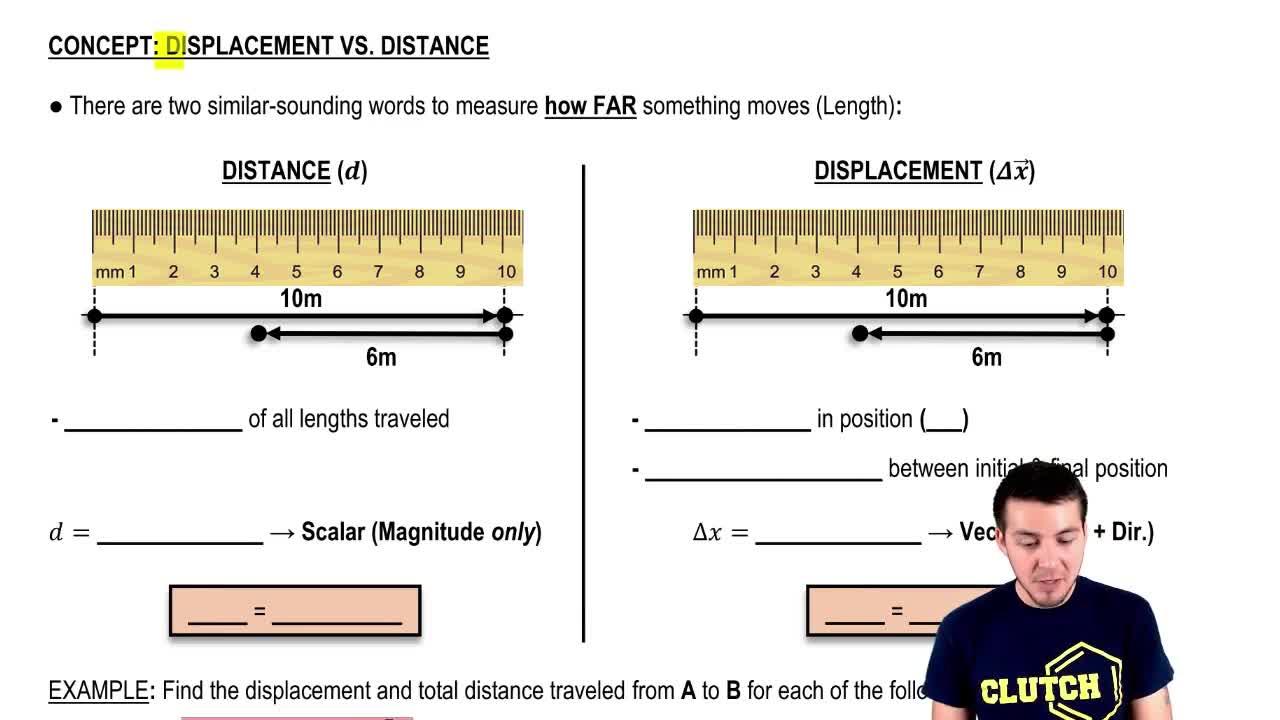
 06:13
06:13