 Back
BackPhysics Final Exam Study Guide
 05:17
05:17
Terms in this set (27)
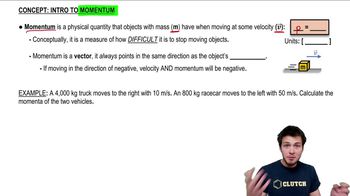
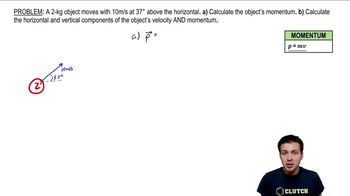
Momentum depends on mass and velocity and is given by \(p=mv\).
Impulse is the force applied over a time interval, expressed as \(J=F\Delta t\).
Impulse changes momentum according to \(J=\Delta p\).
Increase the force applied or increase the time interval over which the force is applied.
Follow-through increases the contact time, which increases impulse and thus changes momentum more effectively.
Increasing contact time spreads the force over a longer period, reducing the peak force experienced.
Total momentum is conserved in all collisions.
Elastic collisions conserve both momentum and kinetic energy; inelastic collisions conserve momentum but not kinetic energy.
A collision where objects stick together after impact.
\(m_1v_{1i} + m_2v_{2i} = m_1v_{1f} + m_2v_{2f}\)
Work is force times distance: \(W=Fd\).
Potential energy is given by \(PE=mgh\).
Kinetic energy is \(KE=\frac{1}{2}mv^2\).
Power is work done over time: \(P=\frac{W}{t}\).
Kinetic energy increases by the square of the speed increase, so it becomes 9 times greater.
\(F=G\frac{m_1m_2}{r^2}\)
Gravity force becomes one-fourth as strong when distance doubles.
Gravity force quadruples when both masses double.
They are in free fall, continuously falling around Earth, creating a sensation of weightlessness.
\(t' = \frac{t}{\sqrt{1 - \frac{v^2}{c^2}}}\)
Because of time dilation, moving clocks run slower relative to stationary observers.
\(L' = L\sqrt{1 - \frac{v^2}{c^2}}\)
Objects contract in length along the direction of motion.
\(E=mc^2\)
Mass bends spacetime, causing objects to follow curved paths, which we perceive as gravity.
Stronger gravity causes time to slow down due to spacetime curvature.
Surface gravity increases because gravity is inversely proportional to the square of the radius.