 Back
BackPhysics Key Concepts and Principles
 08:01
08:01
Terms in this set (28)
An object remains at rest or in uniform motion unless acted upon by a net external force, illustrating the concept of inertia.
Acceleration is proportional to net force and inversely proportional to mass, expressed as \(F=ma\).
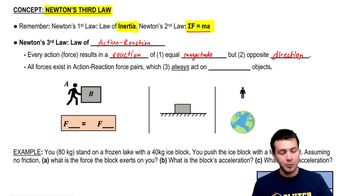
For every action, there is an equal and opposite reaction between two interacting objects.
Momentum is the product of mass and velocity, \(p=mv\), and is a vector quantity.
Impulse is the change in momentum caused by a force applied over time: \(J=F\Delta t=\Delta p\).
In a closed system with no external forces, total momentum remains constant: \(p_{initial} = p_{final}\).
Voltage across a conductor is proportional to current and resistance: \(V=IR\).
Resistance depends on resistivity, length, and cross-sectional area: \(R=\rho \frac{L}{A}\).
Power is the rate of energy conversion: \(P=VI\), also \(P=I^2R\) or \(P=\frac{V^2}{R}\).
Electric field is force per unit charge: \(\vec{E} = \frac{\vec{F}}{q}\), measured in N/C or V/m.
Force between two point charges: \(F = k_e \frac{|q_1 q_2|}{r^2}\), attractive or repulsive depending on charge signs.
Pressure applied to a confined fluid is transmitted equally in all directions.
An object immersed in fluid experiences an upward buoyant force equal to the weight of displaced fluid: \(F_b = \rho_{fluid} V_{displaced} g\).
Within elastic limits, stress is proportional to strain: \(\text{Stress} = E \times \text{Strain}\), where E is Young's modulus.
The angle of incidence equals the angle of reflection: \(\theta_i = \theta_r\).
Refraction of light between media: \(n_1 \sin \theta_1 = n_2 \sin \theta_2\).
Occurs when light passes from denser to less dense medium at angle > critical angle: \(\sin \theta_c = \frac{n_2}{n_1}\).
Ability to store charge per voltage: \(C=\frac{Q}{V}\), energy stored: \(U=\frac{1}{2} C V^2\).
Velocity under constant acceleration: \(v = v_0 + at\).
Horizontal range: \(R = \frac{v_0^2 \sin 2\theta}{g}\).
Force on charge moving in magnetic field: \(\vec{F} = q (\vec{v} \times \vec{B})\).
Induced EMF equals negative rate of change of magnetic flux: \(\mathcal{E} = -\frac{\Delta \Phi_B}{\Delta t}\).
Number of nuclei decreases exponentially: \(N(t) = N_0 e^{-\lambda t}\).
Time for half the nuclei to decay: \(t_{1/2} = \frac{\ln 2}{\lambda}\).
Measured in decibels: \(L = 10 \log_{10} \left( \frac{I}{I_0} \right)\), where I is intensity and I0 is threshold.
Observed frequency: \(f' = f \cdot \frac{v + v_o}{v - v_s}\), with source and observer velocities.
Change in internal energy equals heat added minus work done: \(\Delta U = Q - W\).
Net work done equals change in kinetic energy: \(W_{net} = \Delta KE = \frac{1}{2} m v_f^2 - \frac{1}{2} m v_i^2\).