 Back
BackPhysics: Kinematics Equations
 09:00
09:00
Terms in this set (20)
Displacement is given by \(x = v t\), where v is velocity and t is time.
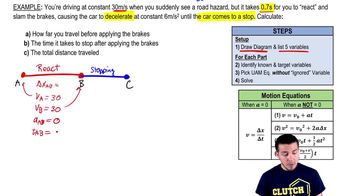
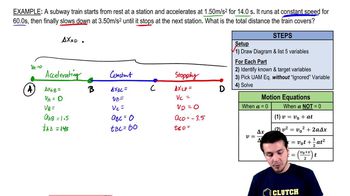
Velocity is given by \(v = v_0 + a t\), where v_0 is initial velocity, a is acceleration, and t is time.
Displacement is \(x = v_0 t + \frac{1}{2} a t^2\), where v_0 is initial velocity, a is acceleration, and t is time.
Velocity squared is \(v^2 = v_0^2 + 2 a x\), where v_0 is initial velocity, a is acceleration, and x is displacement.
Initial velocity (v_0) is the velocity of an object at the start of the time interval.
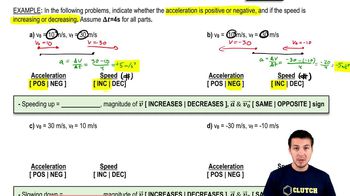
Acceleration is the rate of change of velocity with respect to time.
Average velocity is \(\frac{v_0 + v}{2}\), the mean of initial and final velocities.
Displacement is \(x = \frac{v_0 + v}{2} t\), where t is time.
They assume constant acceleration and motion in a straight line.
Use \(x = v_0 t + \frac{1}{2} a t^2\) and solve for t.
It gives the velocity at any time t under constant acceleration.
Displacement is \(x = \frac{1}{2} a t^2\) when v_0 = 0.
It allows finding final velocity without knowing time.
Velocity changes with displacement according to \(v^2 = v_0^2 + 2 a x\).
Displacement is the change in position of an object from its starting point.
Use the same equations with a = g, acceleration due to gravity.
Acceleration is measured in meters per second squared (m/s²).
Rearrange \(v = v_0 + a t\) to solve for t.
Velocity includes direction; speed is scalar without direction.
They describe motion under constant acceleration, fundamental for mechanics.