Skip to main content
Physics with Calculus
My Course
Learn
Exam Prep
AI Tutor
Study Guides
Textbook Solutions
Flashcards
Explore
Try the app
My Course
Learn
Exam Prep
AI Tutor
Study Guides
Textbook Solutions
Flashcards
Explore
Try the app
Back
Physics with Calculus: 1D and 2D Motion Review
You can tap to flip the card.
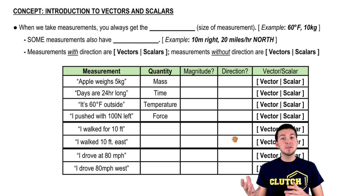
Difference between vector and scalar quantities
You can tap to flip the card.
👆
Difference between vector and scalar quantities
Vectors
have magnitude and direction;
scalars
have only magnitude.
Track progress
Control buttons has been changed to "navigation" mode.
1/21
Recommended videos
Guided course
06:13
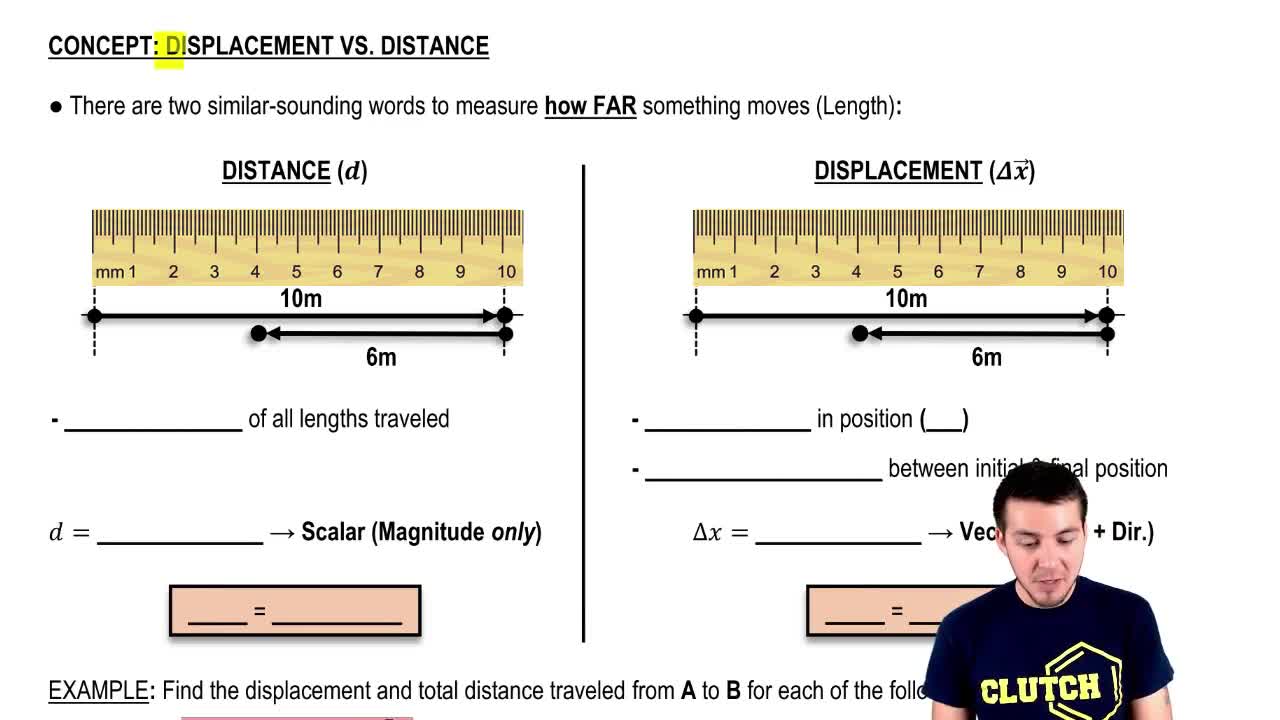
Displacement vs. Distance
22367
views
586
rank
7
comments
Guided course
04:06
Introduction to Vectors and Scalars
31240
views
1098
rank
1
comments
Terms in this set (21)
Hide definitions
Difference between vector and scalar quantities
Vectors
have magnitude and direction;
scalars
have only magnitude.
Identify: Velocity, Distance, Displacement, Speed, Acceleration, Time as vector or scalar
Velocity, Displacement, Acceleration are
vectors
. Distance, Speed, Time are
scalars
.
How to find resultant displacement of a rabbit running 40 m east then 100 m north
Use Pythagorean theorem: resultant = \(\sqrt{40^2 + 100^2}\).
Distance fallen by a pumpkin thrown downward at 8 m/s for 4 s
Use \(d = v_i t + \frac{1}{2}gt^2\) with
g = 9.8 m/s²
.
Velocity of pumpkin just before hitting ground after 4 s fall
Use \(v = v_i + gt\) with
g = 9.8 m/s²
.
Acceleration comparison at different points of a projectile's path
Acceleration is constant and downward at
−9.8 m/s²
throughout the projectile's flight.
Velocity at the apex of a projectile's path
Vertical velocity is
0 m/s
at the apex; horizontal velocity remains constant.
Time to return to ground if projectile takes 2 s to reach apex
Total time of flight is \(2 \times 2 = 4\) seconds.
Horizontal distance traveled by a car driving off a cliff at 40 m/s and air time 5 s
Horizontal distance = velocity × time = \(40 \times 5 = 200\) m.
Height of cliff if car is in air for 5 seconds
Use \(h = \frac{1}{2}gt^2\) with
g = 9.8 m/s²
and \(t=5\) s.
Acceleration sign during intervals of a car's speed increasing and decreasing
Positive acceleration when speed increases, negative when speed decreases, zero when speed is constant.
Greatest positive acceleration interval from speed-time data
Interval with largest increase in speed per time has greatest positive acceleration.
Zero acceleration interval from speed-time data
Interval where speed remains constant has zero acceleration.
Negative acceleration interval from speed-time data
Interval where speed decreases has negative acceleration.
Range comparison: arrow shot at 30° vs arrow shot horizontally
Arrow shot at 30° travels a
greater horizontal distance
than one shot horizontally.
Vertical and horizontal acceleration at apex of projectile
Vertical acceleration =
−9.8 m/s²
, horizontal acceleration =
0 m/s²
.
Which quantity remains constant for a football thrown at 15° angle?
Acceleration
remains constant (gravity), other quantities change.
Horizontal velocity of marble launched from 1.2 m height landing 0.52 m away in 0.51 s
Horizontal velocity = distance / time = \(\frac{0.52}{0.51}\) m/s.
Final speed of a cat moving at 1 m/s accelerating at 0.2 m/s² for 5 s
Final speed = initial speed + acceleration × time = \(1 + 0.2 \times 5 = 2\) m/s.
Acceleration magnitude of football player slowing from 8 m/s to 2 m/s over 15 m
Use kinematic equation \(v^2 = v_0^2 + 2a d\) to solve for
a
.
Distance traveled by object accelerating at 0.5 m/s² east for 20 s from 10 m/s
Use \(d = v_0 t + \frac{1}{2} a t^2\) to find distance.
 BackBack
 06:13