Skip to main content
Physics with Calculus
My Course
Learn
Exam Prep
AI Tutor
Study Guides
Textbook Solutions
Flashcards
Explore
Try the app
My Course
Learn
Exam Prep
AI Tutor
Study Guides
Textbook Solutions
Flashcards
Explore
Try the app
Back
Physics with Calculus - Exam 1 Practice Concepts
You can tap to flip the card.
Equation for velocity with constant acceleration
You can tap to flip the card.
👆
Equation for velocity with constant acceleration
Velocity is given by \(v_f = v_i + at\), where
v_f
is final velocity,
v_i
initial velocity,
a
acceleration, and
t
time.
Track progress
Control buttons has been changed to "navigation" mode.
1/20
Recommended videos
Guided course
06:03
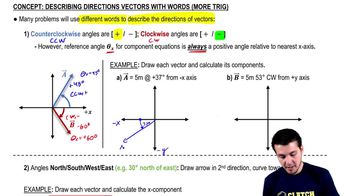
Describing Vectors with Words (More Trig)
8944
views
140
rank
2
comments
Guided course
09:44
Doing Math with Vectors in any Quadrant (More Trig)
13417
views
180
rank
3
comments
Terms in this set (20)
Hide definitions
Equation for velocity with constant acceleration
Velocity is given by \(v_f = v_i + at\), where
v_f
is final velocity,
v_i
initial velocity,
a
acceleration, and
t
time.
Equation for position with constant acceleration
Position is \(x = x_i + v_i t + \frac{1}{2} a t^2\), where
x_i
is initial position.
Formula for acceleration from velocity and time
Acceleration is \(a = \frac{\Delta v}{\Delta t}\), the change in velocity over change in time.
Newton's Second Law
Force is \(\vec{F} = m \vec{a}\), where
m
is mass and
a
acceleration.
Kinetic energy formula
Kinetic energy is \(K = \frac{1}{2} m v^2\), where
m
is mass and
v
velocity.
Potential energy near Earth's surface
Potential energy is \(U = m g y\), where
g
is gravitational acceleration and
y
height.
Work done by a force
Work is \(W = \int \vec{F} \cdot d\vec{r}\), the integral of force over displacement.
Impulse-momentum theorem
Impulse \(\vec{J} = \int \vec{F} dt = \Delta \vec{p}\), equals change in momentum.
Angular velocity and linear velocity relation
Linear velocity \(v = r \omega\), where
r
is radius and
\(\omega\)
angular velocity.
Rotational kinetic energy
Rotational kinetic energy is \(K = \frac{1}{2} I \omega^2\), where
I
is moment of inertia.
Torque and angular acceleration
Torque is \(\vec{\tau} = I \vec{\alpha}\), where
\(\alpha\)
is angular acceleration.
Period of a simple pendulum
Period is \(T = 2 \pi \sqrt{\frac{\ell}{g}}\), where
\(\ell\)
is length and
g
gravity.
Relationship between vectors S, M, and N in the triangle
From the figure,
S = M - N
.
Value of sin 53°
From the trig table,
sin 53° = 4/5
.
Value of cos 37°
From the trig table,
cos 37° = 4/5
.
Value of tan 30°
From the trig table,
tan 30° = \(\sqrt{3}\)/3
.
Acceleration of ISS relative to g
The ISS acceleration is approximately
0.88 g
.
Initial speed for projectile landing 100 m away at 53°
Initial speed is about
32 m/s
.
Time for hay bale to fall from 180 m
Time to land is about
6.1 seconds
.
Distance between hay bales dropped every 2 seconds at 50 m/s
Distance between bales is about
100 m
.
 BackBack
 06:03