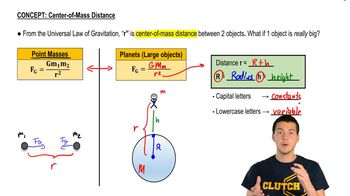
Every body attracts every other body with a force directly proportional to the product of their masses and inversely proportional to the square of the distance between their centers.
Effect on gravitational force if mass of one object is halved
The gravitational force becomes half as large, i.e., new force is \(\frac{1}{2}F\).
Effect on gravitational force if mass of one object is doubled
The gravitational force doubles, i.e., new force is \(2F\).
Difference between mass and weight
Mass is a fixed property of an object; weight depends on the environment and gravitational field strength.
Why is acceleration due to gravity (g = 9.8 m/s²) treated as constant near Earth's surface?
Because the height of a tall mountain is negligible compared to Earth's radius, so distance to Earth's center barely changes.
Scientist who developed the law of universal gravitation
Isaac Newton.
Scientist who developed the idea that gravity warps space-time
Albert Einstein.
Magnitude of acceleration due to gravity at Earth's center
Zero, because gravitational forces from all directions cancel out.
Reading on a bathroom scale in free fall
Zero, because both the person and scale are in free fall, creating weightlessness.
How does gravitational force change with distance?
Gravity gets weaker as the distance between two objects increases.
Comparison of gravitational forces between two objects
The magnitude of the force each exerts on the other is equal, per Newton's third law.
Why do we feel only Earth's gravity daily despite universal attraction?
Earth is massive and close enough to produce a noticeable gravitational force compared to other objects.
Cause of ocean tides
The Moon creates tidal bulges on the sides of Earth closest and farthest from it.
Why don't we feel gravitational pull from nearby people?
Their gravitational force is too small to be physically sensed.
Does mass change on the Moon compared to Earth?
No, mass is constant regardless of location; weight changes due to gravity.
What happens during spring tides?
Spring tides occur when the Sun, Earth, and Moon are aligned, causing higher tides.
What does closely spaced gravitational field lines indicate?
A stronger gravitational field at that point.
Weakest of the four fundamental forces
Gravitational force.
Relationship between tangential velocity and gravitational force for orbiting bodies
They act at right angles to each other.
Scientist who measured the gravitational constant G
Henry Cavendish.
Can gravitational force be blocked, repulsive, or zero?
No; gravitational force cannot be blocked, is never repulsive, and is never zero between two masses.
What happens when a star's escape velocity exceeds the speed of light?
The star becomes a black hole.
Gravity causes which large-scale effects?
Earth's round shape, ocean tides, and mutual attraction of all bodies.
 Back
 01:54