 Back
Physics with Calculus: Motion, Velocity, and Acceleration
 06:13

Terms in this set (20)
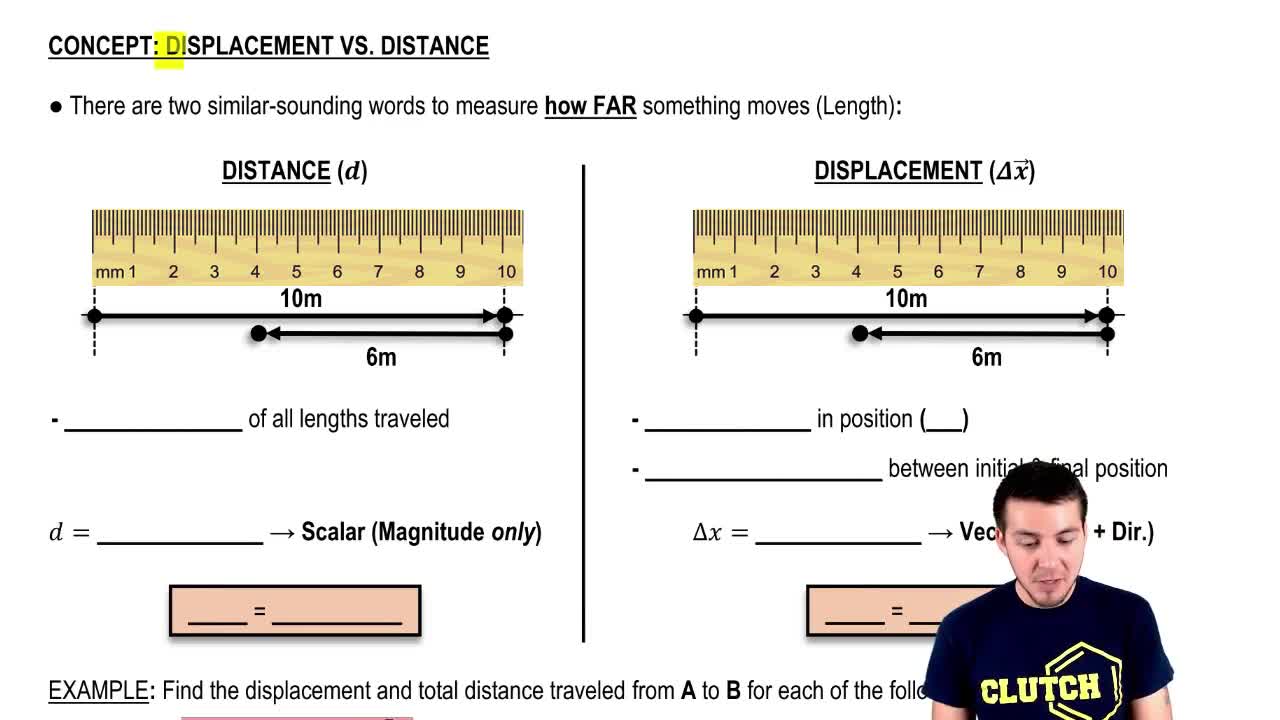
Displacement is a vector showing change in position, including both magnitude and direction.
Position is a scalar indicating where an object is relative to a reference point.
Displacement is a vector representing change in position, while position is a scalar representing location relative to a reference.
Velocity is the rate of change of displacement; it is a vector quantity.
No, if displacement is not changing, velocity is zero.
Acceleration is the rate of change of velocity; it is a vector quantity.
No, acceleration occurs only when velocity changes.
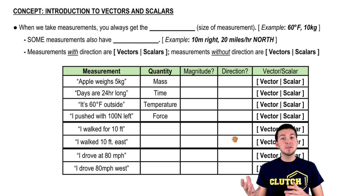
Speed is a scalar representing magnitude only, while velocity is a vector including direction.
Velocity is given by \(v = at\), where a is acceleration and t is time.
Velocity in free fall is \(v = gt\), where g = 9.81 m/s².
Acceleration is constant and depends on the slope and friction of the ramp.
Acceleration is constant at 9.81 m/s² downward due to gravity.
Distance is \(d = \frac{1}{2} a t^2\), where a is acceleration and t is time.
Because velocity changes during acceleration, so \(d \neq vt\).
Negative velocity means motion in the opposite direction of the defined positive axis, not necessarily slowing down.
Sum the individual displacement vectors to get the net displacement.
Net displacement is 4 m north.
Net displacement is the vector sum of movements; net position is the final location relative to the start.
Velocity is \(v = at = 2 \times 3 = 6\, m/s\).
Velocity is \(v = gt = 9.81 \times 4 = 39.24\, m/s\) downward.