Back

Physics with Calculus: Newton's Laws, Forces, Work, and Energy

Control buttons has been changed to "navigation" mode.
1/18
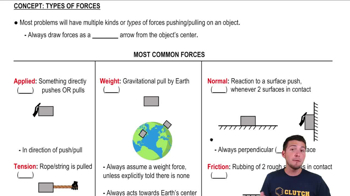
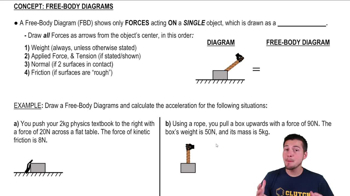
  • Newton's 2nd law for a stationary book on a table


    Sum of forces in vertical direction is zero; normal force equals weight: \(N = mg\).
  • Newton's 2nd law for a book pushed at constant velocity

    Net force is zero; friction force equals applied force; acceleration is zero.
  • Newton's 2nd law for a book accelerating across a table

    Net force equals mass times acceleration: \(F_{net} = ma\).
  • Tension in a rope pulling a box at angle θ with constant velocity

    Friction force equals horizontal component of tension; normal force adjusted by vertical component: \(N = mg - T \sin\theta\).
  • Friction force on a box pulled at constant velocity with tension T at 30°

    Friction force magnitude equals horizontal tension component: \(f = T \cos 30^\circ\).
  • Normal force on a box pulled at 30° with tension T

    Normal force is weight minus vertical tension component: \(N = mg - T \sin 30^\circ\).
  • Friction and normal forces on a block resting on a ramp at angle θ

    Normal force: \(N = mg \cos \theta\); friction force opposes motion along ramp.
  • Tension in strings suspending multiple masses

    Tension in each segment equals weight of masses below it.
  • Coefficient of static friction when blocks are stationary

    Calculated by balancing friction force and applied force: \(\mu_s = \frac{f_s}{N}\).
  • Acceleration of connected blocks with no friction

    Use Newton's 2nd law for each block and solve system: \(a = \frac{(m_2 - m_1)g}{m_1 + m_2}\).
  • Maximum speed around a curve without slipping

    Use centripetal force and friction: \(v_{max} = \sqrt{\mu_s g r}\).
  • Work done by a force applied at an angle θ over distance d

    Work: \(W = F d \cos \theta\).
  • How would you calculate the total work from force-position graph


    Sum areas under force curve considering sign; positive area adds work, negative subtracts.
  • Compression of spring from dropped ball

    Use energy conservation: \(mgh = \frac{1}{2}kx^2\) to solve for \(x\).
  • Car stopping distance with drag force and friction

    Use work-energy principle including work done by drag: \(\frac{1}{2}mv^2 = mgd\sin\theta + F_{drag} d\).
  • Speed of block before hitting spring on frictionless hill

    Use energy conservation: \(v = \sqrt{2gh}\).
  • Maximum spring compression with friction

    Energy lost to friction reduces compression: \(\frac{1}{2}kx^2 = mgd + \text{friction work}\).
  • Work done by air resistance on falling object

    Difference between gravitational potential energy and kinetic energy: \(W_{air} = mg h - \frac{1}{2}mv^2\).