 Back
Physics with Calculus: Work, Energy, Momentum, and Collisions
 04:41

Terms in this set (20)
The work-energy theorem states that the net work done on an object equals its change in kinetic energy.
Kinetic energy is the energy an object has due to its motion, given by \(K=\frac{1}{2}mv^2\).
Gravitational potential energy is energy stored due to an object's position, calculated as \(U=mgh\).
An energy diagram shows how potential and kinetic energy vary with position, illustrating energy conservation and transitions.
In the absence of non-conservative forces, the total mechanical energy (kinetic + potential) remains constant.
Power is the rate at which work is done or energy is transferred, given by \(P=\frac{W}{t}\).
Linear momentum is the product of an object's mass and velocity, \(\vec{p}=m\vec{v}\).
Impulse is the change in momentum caused by a force applied over time, \(\vec{J}=\vec{F}\Delta t=\Delta \vec{p}\).
Force is the time rate of change of momentum, \(\vec{F}=\frac{d\vec{p}}{dt}\).
The total momentum of a closed system remains constant if no external forces act on it.
In elastic collisions, kinetic energy is conserved; in inelastic collisions, some kinetic energy is lost.
During collisions, the vector sum of momenta before impact equals the vector sum after, \(\sum \vec{p}_{initial} = \sum \vec{p}_{final}\).
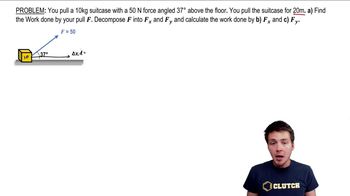
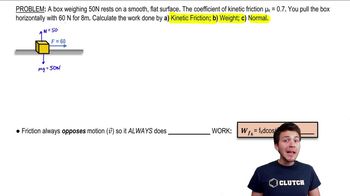
Work done is \(W=\vec{F} \cdot \vec{d} = Fd\cos\theta\), where θ is the angle between force and displacement.
Mechanical energy is the sum of kinetic and potential energies in a system.
Impulse quantifies the effect of a force acting over a time interval, changing an object's momentum.
They visualize how potential and kinetic energy interchange, helping predict speeds and positions.
Power can be expressed as \(P=\vec{F} \cdot \vec{v}\), the dot product of force and velocity.
Objects stick together or deform, kinetic energy decreases, but momentum is conserved.
The impulse applied to an object equals its change in momentum, \(\vec{J}=\Delta \vec{p}\).
Kinetic energy depends on the square of velocity, \(K=\frac{1}{2}mv^2\).