Skip to main content
Physics with Calculus
My Course
Learn
Exam Prep
AI Tutor
Study Guides
Textbook Solutions
Flashcards
Explore
Try the app
My Course
Learn
Exam Prep
AI Tutor
Study Guides
Textbook Solutions
Flashcards
Explore
Try the app
Back
Universal Gravity and Gravitational Concepts
You can tap to flip the card.
What is the nature of the orbits of the Moon around Earth and Earth around the Sun?
You can tap to flip the card.
👆
What is the nature of the orbits of the Moon around Earth and Earth around the Sun?
They are nearly circular orbits with roughly constant speeds, resulting in centripetal acceleration.
Track progress
Control buttons has been changed to "navigation" mode.
1/20
Recommended videos
Guided course
01:54
Find force between spheres with radii
6710
views
112
rank
2
comments
Guided course
07:45
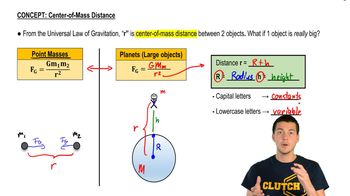
Center of Mass Distance
8664
views
152
rank
2
comments
Guided course
05:40
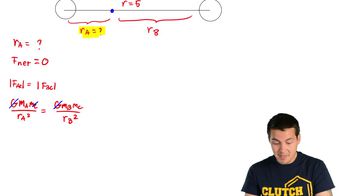
Where is Net Force on middle object zero?
9167
views
166
rank
2
comments
Terms in this set (20)
Hide definitions
What is the nature of the orbits of the Moon around Earth and Earth around the Sun?
They are nearly circular orbits with roughly constant speeds, resulting in centripetal acceleration.
What causes the centripetal acceleration of Earth around the Sun?
A force due to gravity acts as a field force causing centripetal acceleration.
How does the strength of gravity change with distance?
Gravity weakens with distance following an inverse-square law, proportional to 1/r².
How does a solid sphere exert gravitational force?
It exerts force as if all its mass is concentrated at its center.
What is the relationship between the period squared and radius cubed of planetary orbits?
The square of the orbital period is proportional to the cube of the orbit's radius (T² ∝ R³).
How is gravitational force between two masses expressed according to Newton's law?
It is proportional to the product of their masses and inversely proportional to the square of the distance: F = G (m1 m2) / r².
What is the gravitational constant G and its value?
G is the proportionality constant in Newton's law of gravity, with value 6.67 × 10⁻¹¹ N·m²/kg².
How is mass related to inertia and gravitational pull?
Mass is proportional to inertia and determines the strength of gravitational pull on an object.
Why do astronauts feel weightless in orbit despite gravity acting on them?
They are in free fall, so the scale reads zero and they experience weightlessness.
What does a spring scale measure in terms of weight?
It measures the downward force exerted on it, which can change with acceleration.
How does acceleration of an elevator affect the reading of a spring scale inside it?
If accelerating downward, the scale reads less; if acceleration equals g downward, the scale reads zero.
What is gravitational potential energy between two masses?
It is the energy due to gravitational attraction, given by U = -G (m1 m2) / r.
How does gravitational potential energy near Earth's surface relate to height change?
For small height changes, ΔU ≈ mgΔx, where g is acceleration due to gravity.
Is the work done by gravity path-dependent or path-independent?
It is path-independent; work depends only on initial and final positions.
What happens to the work done by gravity over a closed path?
The net work done by gravity over a closed path is zero.
How does the gravitational force between two objects depend on their masses and distance?
It is proportional to the product of their masses and inversely proportional to the square of the distance between them.
What is the significance of the Cavendish experiment?
It was the first measurement of the gravitational constant G.
How does a balance scale measure mass on Earth or the Moon?
It compares gravitational forces and balances the rod, measuring mass independent of gravity.
What is the difference between mass and weight?
Mass is the amount of matter; weight is the gravitational force acting on that mass.
Why does a brick in free fall feel weightless?
Because both the brick and scale fall together, no force is exerted between them.
 BackBack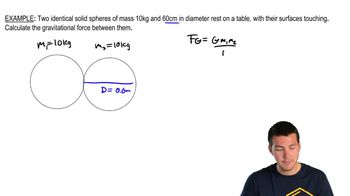
 01:54
01:54