Skip to main content
Precalculus
My Course
Learn
Exam Prep
AI Tutor
Study Guides
Flashcards
Explore
Try the app
My Course
Learn
Exam Prep
AI Tutor
Study Guides
Flashcards
Explore
Try the app
Back
Asymptotes definitions
You can tap to flip the card.
Asymptote
You can tap to flip the card.
👆
Asymptote
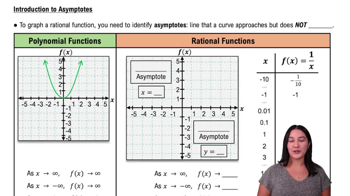
A line that a graph approaches infinitely closely but never touches, shaping the behavior of rational functions.
Track progress
Control buttons has been changed to "navigation" mode.
1/15
Related flashcards
Related practice
Recommended videos
Asymptotes quiz
Asymptotes
15 Terms
Asymptotes
5. Rational Functions
3 problems
Topic
Graphing Rational Functions
5. Rational Functions
4 problems
Topic
5. Rational Functions
3 topics
5 problems
Chapter
Guided course
4:48
Determining Horizontal Asymptotes
1226
views
18
rank
Guided course
6:24
Introduction to Asymptotes
2178
views
43
rank
Guided course
3:12
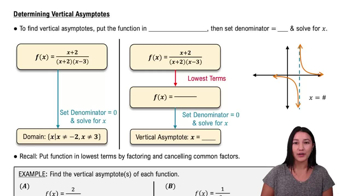
Determining Vertical Asymptotes
1482
views
36
rank
Terms in this set (15)
Hide definitions
Asymptote
A line that a graph approaches infinitely closely but never touches, shaping the behavior of rational functions.
Rational Function
A function expressed as the ratio of two polynomials, often exhibiting asymptotic behavior.
Horizontal Asymptote
A horizontal line indicating the value a function approaches as x moves toward positive or negative infinity.
Vertical Asymptote
A vertical line where a function's value increases or decreases without bound as x approaches a specific value.
End Behavior
The trend of a graph as x approaches infinity or negative infinity, often influenced by asymptotes.
Lowest Terms
A simplified form of a rational function where all common factors between numerator and denominator are canceled.
Common Factor
An expression that divides both the numerator and denominator, whose cancellation may create a hole in the graph.
Hole
A point of discontinuity on a graph, marked by an open circle, resulting from a canceled common factor.
Removable Discontinuity
A technical term for a hole in a graph, occurring where a common factor is canceled from a rational function.
Domain
The set of all possible input values for a function, restricted by vertical asymptotes and holes.
Range
The set of all possible output values for a function, often influenced by horizontal asymptotes.
Degree
The highest exponent of a variable in a polynomial, used to determine the presence and location of horizontal asymptotes.
Leading Coefficient
The coefficient of the term with the highest degree in a polynomial, used to find horizontal asymptotes when degrees are equal.
Dashed Line
A graphical representation used to indicate the location of an asymptote on a coordinate plane.
Removable Factor
A factor that, when canceled from both numerator and denominator, creates a hole rather than an asymptote.
 BackBack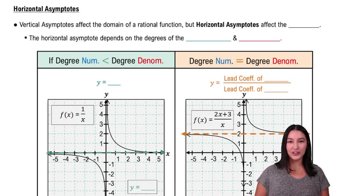
 4:48
4:48