Skip to main content
Precalculus
My Course
Learn
Exam Prep
AI Tutor
Study Guides
Flashcards
Explore
Try the app
My Course
Learn
Exam Prep
AI Tutor
Study Guides
Flashcards
Explore
Try the app
Back
Introduction to Conic Sections quiz
You can tap to flip the card.
What is a conic section?
You can tap to flip the card.
👆
What is a conic section?
A conic section is a shape formed by slicing a three-dimensional cone with a two-dimensional plane.
Track progress
Control buttons has been changed to "navigation" mode.
1/15
Related flashcards
Related practice
Recommended videos
Introduction to Conic Sections definitions
Introduction to Conic Sections
15 Terms
Introduction to Conic Sections
19. Conic Sections
4 problems
Topic
Circles
19. Conic Sections
2 problems
Topic
19. Conic Sections
6 topics
9 problems
Chapter
3:08
Geometries from Conic Sections
1023
views
16
rank
Terms in this set (15)
Hide definitions
What is a conic section?
A conic section is a shape formed by slicing a three-dimensional cone with a two-dimensional plane.
How is a circle formed as a conic section?
A circle is formed by slicing a cone horizontally with a plane.
What shape results from slicing a cone at a slight angle?
Slicing a cone at a slight angle produces an ellipse.
How is an ellipse different from a circle in terms of slicing the cone?
An ellipse is formed by a slightly tilted slice, making it an oval, while a circle is formed by a horizontal slice.
What conic section is created by slicing a cone at a heavily tilted angle?
A parabola is created by slicing the cone at a heavily tilted angle.
How does the angle of the slicing plane affect the shape of the conic section?
The angle of the slicing plane determines whether the conic section is a circle, ellipse, parabola, or hyperbola.
What is the result of slicing a cone vertically with a plane?
Slicing a cone vertically produces a hyperbola.
Describe the appearance of a hyperbola.
A hyperbola consists of two curves that diverge away from each other.
Why is the slicing cone analogy useful in studying conic sections?
The slicing cone analogy helps students remember the different types of conic sections and how they are formed.
What is the main difference between the ellipse and the parabola in terms of the slicing angle?
An ellipse is formed by a slight tilt, while a parabola is formed by a much heavier tilt of the slicing plane.
What do all conic sections have in common regarding equations?
Each conic section has an associated equation that describes its shape.
Which conic section is described as the most unique in the lesson?
The hyperbola is described as the most unique conic section.
What happens to the plane when forming a parabola from a cone?
The plane is heavily tilted, causing part of it to pop off the end of the cone, forming a parabola.
How can you visually distinguish an ellipse from a circle in conic sections?
An ellipse appears as a stretched-out oval, while a circle is perfectly round.
What will future videos in the series focus on regarding conic sections?
Future videos will explore the equations and graphs associated with each conic section.
 BackBack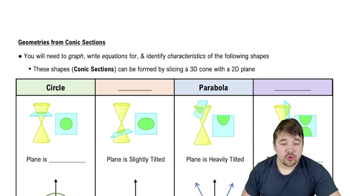
 3:08
3:08