Skip to main content
Precalculus
My Course
Learn
Exam Prep
AI Tutor
Study Guides
Flashcards
Explore
Try the app
My Course
Learn
Exam Prep
AI Tutor
Study Guides
Flashcards
Explore
Try the app
Back
Limits at Infinity definitions
You can tap to flip the card.
Limit
You can tap to flip the card.
👆
Limit
The value a function approaches as its input gets arbitrarily close to a specific point or infinity.
Track progress
Control buttons has been changed to "navigation" mode.
1/15
Related flashcards
Related practice
Recommended videos
Limits at Infinity quiz
Limits at Infinity
15 Terms
Limits at Infinity
23. Intro to Derivatives & Area Under the Curve
5 problems
Topic
Limits of Sequences
23. Intro to Derivatives & Area Under the Curve
5 problems
Topic
23. Intro to Derivatives & Area Under the Curve
4 topics
12 problems
Chapter
06:25
Finding Limits at Infinity Algebraically
371
views
4
rank
04:55
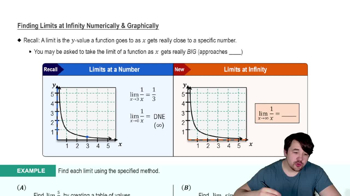
Finding Limits at Infinity Numerically and Graphically
481
views
5
rank
02:43
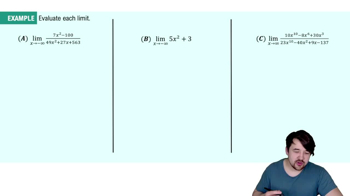
Finding Limits at Infinity Algebraically Example 1
341
views
6
rank
Terms in this set (15)
Hide definitions
Limit
The value a function approaches as its input gets arbitrarily close to a specific point or infinity.
Infinity
A concept describing unbounded growth in either the positive or negative direction on the number line.
Rational Function
An expression formed by dividing one polynomial by another, often analyzed for behavior at extreme values.
Numerator
The top part of a fraction, whose degree is compared to the denominator when evaluating limits at infinity.
Denominator
The bottom part of a fraction, whose degree influences whether a rational function's limit at infinity approaches zero.
Degree
The highest exponent of x in a polynomial, crucial for determining the end behavior of rational functions.
Leading Coefficient
The constant multiplying the term with the highest power of x in a polynomial, used in shortcut methods for limits.
End Behavior
The trend of a function's output as the input becomes extremely large or small, often toward infinity.
Shortcut Method
A quick technique for finding limits at infinity by comparing degrees and leading coefficients of numerator and denominator.
Oscillation
A repeated up-and-down movement in a function's output, preventing the existence of a single limit at infinity.
Positive Infinity
The direction on the x-axis representing values increasing without bound to the right.
Negative Infinity
The direction on the x-axis representing values decreasing without bound to the left.
End Right Behavior
The pattern a function follows as x increases toward positive infinity.
End Left Behavior
The pattern a function follows as x decreases toward negative infinity.
Ratio of Leading Coefficients
The value obtained by dividing the leading coefficient of the numerator by that of the denominator when degrees are equal.
 BackBack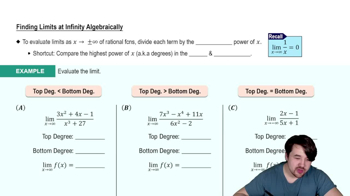
 06:25
06:25