Skip to main content
Precalculus
My Course
Learn
Exam Prep
AI Tutor
Study Guides
Flashcards
Explore
Try the app
My Course
Learn
Exam Prep
AI Tutor
Study Guides
Flashcards
Explore
Try the app
Back
Limits of Sequences quiz
You can tap to flip the card.
What is a sequence in mathematics?
You can tap to flip the card.
👆
What is a sequence in mathematics?
A sequence is similar to a function but has discrete inputs (like 1, 2, 3) and produces a list of outputs, often following a pattern.
Track progress
Control buttons has been changed to "navigation" mode.
1/15
Related flashcards
Related practice
Recommended videos
Limits of Sequences definitions
Limits of Sequences
15 Terms
Limits of Sequences
23. Intro to Derivatives & Area Under the Curve
5 problems
Topic
Area Under a Curve
23. Intro to Derivatives & Area Under the Curve
5 problems
Topic
23. Intro to Derivatives & Area Under the Curve
4 topics
12 problems
Chapter
04:53
Limits of Sequences
326
views
4
rank
Terms in this set (15)
Hide definitions
What is a sequence in mathematics?
A sequence is similar to a function but has discrete inputs (like 1, 2, 3) and produces a list of outputs, often following a pattern.
How do you apply limits to sequences?
Limits are applied to sequences by considering what happens to the sequence's output as the input n approaches infinity.
What is the limit of the sequence a_n = 1/n as n approaches infinity?
The limit is 0, because as n gets larger, 1/n gets closer and closer to 0.
What does it mean for a sequence to converge?
A sequence converges if its outputs approach a specific value as n becomes infinitely large.
What does it mean for a sequence to diverge?
A sequence diverges if its outputs do not approach a specific value as n becomes infinitely large.
What is the limit of the sequence a_n = (8n + 1)/3 as n approaches infinity?
The sequence increases without bound, so it diverges and does not have a finite limit.
What is the behavior of the sequence a_n = (-1)^n as n approaches infinity?
The sequence oscillates between -1 and 1, so it does not converge and diverges.
How can you analyze the behavior of a sequence if you are unsure about its limit?
You can draw out a table of values for increasing n to observe the trend of the sequence.
What shortcut can you use to find the limit of a sequence like a_n = 1/n?
If n is only in the denominator, the sequence approaches 0 as n approaches infinity.
What happens to a sequence if the numerator grows faster than the denominator as n increases?
The sequence will increase without bound and diverge.
How do you describe a sequence whose outputs alternate between two values as n increases?
Such a sequence is said to diverge because it does not approach a single value.
What is a common method to determine if a sequence converges or diverges?
Simplify the sequence's expression and analyze its behavior as n approaches infinity.
What is the output of a_n = (-1)^n for n = 1, 2, 3, and 4?
For n = 1: -1, n = 2: 1, n = 3: -1, n = 4: 1.
What is the significance of a sequence having a limit as n approaches infinity?
It means the sequence converges to a specific value, indicating predictable long-term behavior.
What is the main difference between a function and a sequence?
A function can have any input, while a sequence only has discrete inputs like positive integers.
 BackBack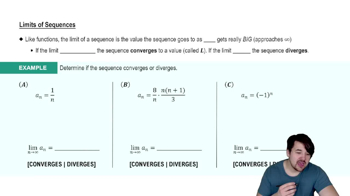
 04:53
04:53