Skip to main content
Precalculus
My Course
Learn
Exam Prep
AI Tutor
Study Guides
Flashcards
Explore
Try the app
My Course
Learn
Exam Prep
AI Tutor
Study Guides
Flashcards
Explore
Try the app
Back
Understanding Polynomial Functions quiz
You can tap to flip the card.
What are the only types of exponents allowed in a polynomial function?
You can tap to flip the card.
👆
What are the only types of exponents allowed in a polynomial function?
Only positive whole number exponents are allowed in a polynomial function; no negatives or fractions.
Track progress
Control buttons has been changed to "navigation" mode.
1/15
Related flashcards
Related practice
Recommended videos
Understanding Polynomial Functions definitions
Understanding Polynomial Functions
14 Terms
Understanding Polynomial Functions
4. Polynomial Functions
5 problems
Topic
Graphing Polynomial Functions
4. Polynomial Functions
2 problems
Topic
4. Polynomial Functions
3 topics
7 problems
Chapter
Guided course
06:04
Introduction to Polynomial Functions
4033
views
150
rank
Guided course
03:42
Finding Zeros & Their Multiplicity
2066
views
78
rank
Guided course
06:08
End Behavior of Polynomial Functions
2233
views
93
rank
Terms in this set (15)
Hide definitions
What are the only types of exponents allowed in a polynomial function?
Only positive whole number exponents are allowed in a polynomial function; no negatives or fractions.
How is a polynomial written in standard form?
A polynomial is written in standard form by combining like terms and arranging terms in descending order of power.
What is the leading coefficient of a polynomial function?
The leading coefficient is the coefficient of the term with the highest power in the polynomial.
How do you determine the degree of a polynomial function?
The degree is the highest exponent of the variable in the polynomial when written in standard form.
Can a polynomial function have a fraction as a coefficient?
Yes, a polynomial function can have a fraction as a coefficient, but not as an exponent.
What are two key features of the graph of any polynomial function?
The graph of any polynomial function is smooth and continuous, with no corners or breaks.
What is the domain of any polynomial function?
The domain of any polynomial function is all real numbers, or from negative infinity to positive infinity.
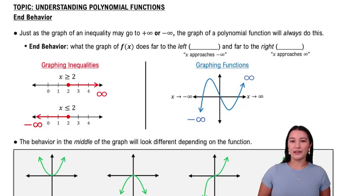
What determines the end behavior of a polynomial function's graph?
The end behavior is determined by the leading coefficient and the degree of the polynomial.
How does the sign of the leading coefficient affect the right end of the graph?
If the leading coefficient is positive, the right end rises; if negative, the right end falls.
What does it mean if the degree of a polynomial is even regarding end behavior?
If the degree is even, both ends of the graph have the same behavior (both rise or both fall).
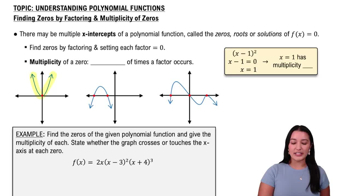
How do you find the x-intercepts (zeros) of a polynomial function?
Set the polynomial equal to zero and solve, usually by factoring, to find the x-intercepts.
What is the multiplicity of a zero, and how does it affect the graph?
Multiplicity is the number of times a factor occurs; even multiplicity means the graph touches and bounces off the axis, odd means it crosses.
How do you determine the maximum number of turning points in a polynomial graph?
The maximum number of turning points is one less than the degree of the polynomial (n - 1).
What are turning points in the context of polynomial graphs?
Turning points are where the graph changes direction from increasing to decreasing or vice versa, and can be local maxima or minima.
If a polynomial has degree 4, what is the maximum number of turning points it can have?
A degree 4 polynomial can have at most 3 turning points.
 BackBack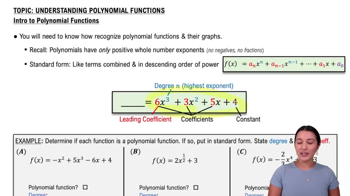
 06:04
06:04