Back

Logarithmic and Exponential Functions - Precalculus

Control buttons has been changed to "navigation" mode.
1/20
  • Definition of logarithmic function with base a

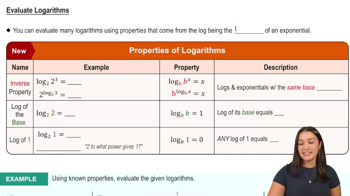
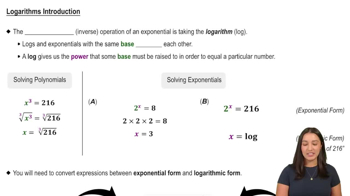
    The logarithmic function with base a, where a > 0 and a ≠ 1, is defined by \(y=\log_a x\) and is the inverse of the exponential function \(x=a^{y}\).

  • Relationship between logarithmic and exponential statements

    The logarithmic statement \(y=\log_a x\) is equivalent to the exponential statement \(a^y=x\).
  • How to change an exponential statement to a logarithmic statement

    Rewrite \(a^b=c\) as \(b=\log_a c\).
  • How to change a logarithmic statement to an exponential statement

    Rewrite \(\log_a b=c\) as \(a^c=b\).
  • Domain of a logarithmic function \(f(x)=\log_a (g(x))\)

    The domain consists of all x such that \(g(x)>0\).
  • Range of a logarithmic function

    The range of \(f(x)=\log_a x\) is all real numbers, \((-\infty, \infty)\).
  • Vertical asymptote of logarithmic function \(f(x)=\log_a x\)

    The vertical asymptote is the y-axis, or the line \(x=0\).
  • Behavior of logarithmic function based on base a

    If \(01\), it is increasing.
  • Key points on the graph of \(y=\log_a x\)

    The graph passes through points \((1,0)\) and \((a,1)\).
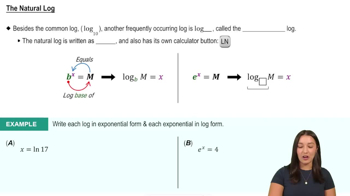
  • Natural logarithm function

    The natural logarithm is the logarithm with base e, denoted \(\ln x = \log_e x\).
  • Inverse of the natural exponential function \(y=e^x\)

    The inverse function is the natural logarithm \(y=\ln x\).
  • Common logarithm function

    The common logarithm has base 10 and is denoted \(\log x = \log_{10} x\).
  • How to find the inverse of a logarithmic function

    Replace \(y=\log_a (x+c)+d\) with \(x=a^{y-d}-c\) and solve for y.
  • How to solve logarithmic equations

    Rewrite the logarithmic equation in exponential form and solve for the variable.
  • How to solve exponential equations using logarithms

    Rewrite the exponential equation in logarithmic form and solve for the variable.
  • Domain of logarithmic function with shifted argument example

    For \(f(x)=\log_a (x+2)\), domain is \(x>-2\).
  • Example of domain restriction for logarithmic function

    For \(g(x)=\log_a (5-x^2)\), domain is \(-5
  • Graphing logarithmic functions using transformations

    Start with the graph of \(y=\log_a x\) and apply shifts, reflections, and stretches.
  • Reflection property of logarithmic and exponential graphs

    The graph of a logarithmic function is the reflection of its exponential inverse about the line \(y=x\).
  • Application: Modeling relative risk with exponential function

    Relative risk R can be modeled as \(R=ae^{kx}\), where x is blood alcohol concentration and k is a constant.