 Back
BackPrecalculus: Trigonometric Functions and Laws
 6:34
6:34
Terms in this set (20)
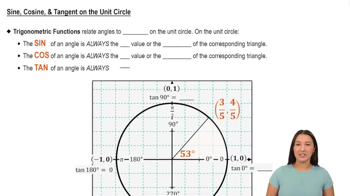
The sine function relates an angle of a right triangle to the ratio of the length of the opposite side over the hypotenuse.
The cosine function relates an angle of a right triangle to the ratio of the adjacent side length over the hypotenuse.
The tangent function is the ratio of the opposite side to the adjacent side in a right triangle.
The Law of Sines states: \(\frac{a}{\sin A} = \frac{b}{\sin B} = \frac{c}{\sin C}\), relating sides and opposite angles in any triangle.
Use the Law of Sines to find unknown sides or angles in any triangle when you know either two angles and one side or two sides and a non-included angle.
The Law of Cosines is: \(c^2 = a^2 + b^2 - 2ab \cos C\), relating sides and the included angle in any triangle.
Use the Law of Cosines to find a side when two sides and the included angle are known, or to find an angle when all three sides are known.
The period of sine and cosine functions is \(2\pi\), meaning the functions repeat every \(2\pi\) radians.
The amplitude is the absolute value of the coefficient before sine or cosine, representing the maximum value of the function.
The general form is \(y = A \sin(Bx + C) + D\), where A is amplitude, B affects period, C is phase shift, and D is vertical shift.
The period is \(\frac{2\pi}{|B|}\), where B is the coefficient of x inside the sine function.
The phase shift is the horizontal shift of the graph, calculated by \(-\frac{C}{B}\) in \(y = A \sin(Bx + C) + D\).
The vertical shift moves the graph up or down by D units in \(y = A \sin(Bx + C) + D\).
The identity is \(\sin^2 \theta + \cos^2 \theta = 1\), true for all angles \(\theta\).
Multiply degrees by \(\frac{\pi}{180}\\) to convert to radians.
Multiply radians by \(\frac{180}{\pi}\\) to convert to degrees.
Sine 90° or \(\sin \frac{\pi}{2}\) equals 1.
Cosine 0° or \(\cos 0\) equals 1.
Tangent 45° or \(\tan \frac{\pi}{4}\) equals 1.
Sine of an angle equals the cosine of its complement: \(\sin \theta = \cos(90^\circ - \theta)\).