 Back
BackAnalytic Trigonometry: Inverse Functions, Equations, and Identities
Study Guide - Smart Notes
 Tailored notes based on your materials, expanded with key definitions, examples, and context.
Analytic Trigonometry
Inverse Sine, Cosine, and Tangent Functions
Inverse trigonometric functions allow us to determine the angle whose trigonometric value is known. These functions are essential for solving equations and understanding the properties of trigonometric functions.
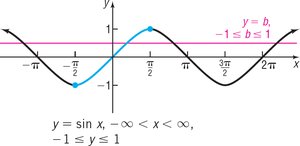
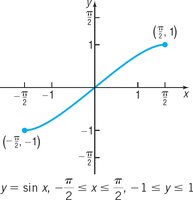
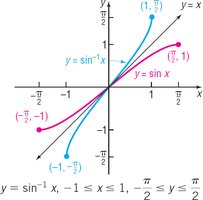
Inverse Sine Function (\( \sin^{-1} x \)): Defined for \( -1 \leq x \leq 1 \), returns an angle \( y \) such that \( \sin y = x \) and \( -\frac{\pi}{2} \leq y \leq \frac{\pi}{2} \).
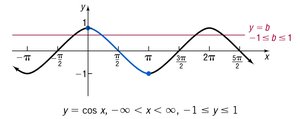
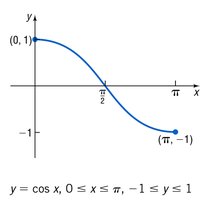
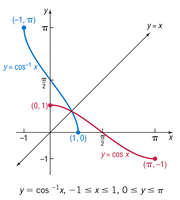
Inverse Cosine Function (\( \cos^{-1} x \)): Defined for \( -1 \leq x \leq 1 \), returns an angle \( y \) such that \( \cos y = x \) and \( 0 \leq y \leq \pi \).
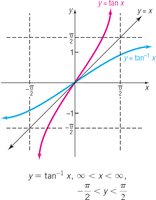
Inverse Tangent Function (\( \tan^{-1} x \)): Defined for all real \( x \), returns an angle \( y \) such that \( \tan y = x \) and \( -\frac{\pi}{2} < y < \frac{\pi}{2} \).
Properties: The graph of a function and its inverse are reflections about the line \( y = x \).
Finding Exact and Approximate Values of Inverse Functions
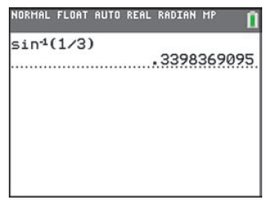
Exact values are found using reference angles and known values from the unit circle. Approximate values are calculated using calculators, often in radian mode.
Example: \( \sin^{-1}(1/3) \approx 0.34 \) radians.
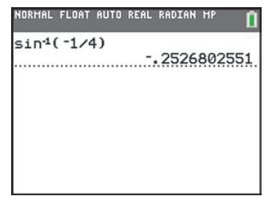
Example: \( \sin^{-1}(-1/4) \approx -0.25 \) radians.
Composite Functions and Properties
Composite functions involving trigonometric and inverse trigonometric functions can often be simplified using properties of these functions. For example, \( \sin(\sin^{-1} x) = x \) for \( x \) in the domain of \( \sin^{-1} \).
Cosine and Inverse Cosine Functions
The cosine function and its inverse are fundamental in trigonometry. The domain and range restrictions are important for defining the inverse.
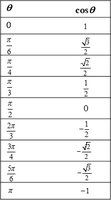
Cosine Values Table
\( \theta \) | \( \cos \theta \) |
|---|---|
0 | 1 |
\( \frac{\pi}{6} \) | \( \frac{\sqrt{3}}{2} \) |
\( \frac{\pi}{4} \) | \( \frac{\sqrt{2}}{2} \) |
\( \frac{\pi}{3} \) | \( \frac{1}{2} \) |
\( \frac{\pi}{2} \) | 0 |
\( \frac{2\pi}{3} \) | \( -\frac{1}{2} \) |
\( \frac{3\pi}{4} \) | \( -\frac{\sqrt{2}}{2} \) |
\( \frac{5\pi}{6} \) | \( -\frac{\sqrt{3}}{2} \) |
\( \pi \) | -1 |
Tangent and Inverse Tangent Functions
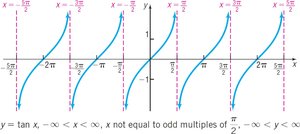
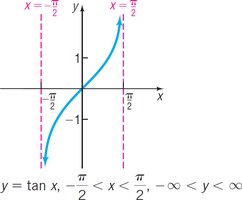
The tangent function is periodic and undefined at odd multiples of \( \frac{\pi}{2} \). Its inverse, \( \tan^{-1} x \), is defined for all real numbers.
Expressions Involving Inverse Trigonometric Functions
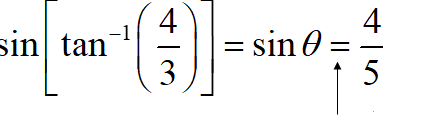
Expressions such as \( \sin(\tan^{-1}(4/3)) \) can be evaluated using right triangle relationships.
Example: \( \sin(\tan^{-1}(4/3)) = \frac{4}{5} \)
Trigonometric Equations
Solving Trigonometric Equations
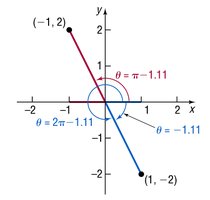
Trigonometric equations can be solved by isolating the trigonometric function and using inverse functions. The general solution often involves adding integer multiples of the period.
Example: For \( \cos \theta = 1/2 \), solutions are \( \theta = \frac{\pi}{3} + 2\pi k \) and \( \theta = \frac{5\pi}{3} + 2\pi k \), where \( k \) is any integer.
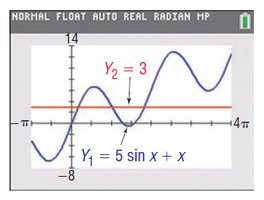
Solving with Calculators and Graphing Utilities
Calculators and graphing utilities are useful for finding approximate solutions and visualizing intersections.
Trigonometric Identities
Types of Identities
Trigonometric identities are equations true for all values in the domain. Common types include:
Quotient Identities: \( \tan \theta = \frac{\sin \theta}{\cos \theta} \)
Reciprocal Identities: \( \csc \theta = \frac{1}{\sin \theta} \), etc.
Pythagorean Identities: \( \sin^2 \theta + \cos^2 \theta = 1 \)
Even-Odd Identities: \( \sin(-\theta) = -\sin \theta \), \( \cos(-\theta) = \cos \theta \)
Simplifying and Establishing Identities
Algebraic techniques such as rewriting in terms of sine and cosine, factoring, and combining ratios are used to simplify expressions and prove identities.
Sum, Difference, Double-Angle, and Half-Angle Formulas
Sum and Difference Formulas
These formulas allow calculation of trigonometric values for sums and differences of angles:
Cosine: \( \cos(a \pm b) = \cos a \cos b \mp \sin a \sin b \)
Sine: \( \sin(a \pm b) = \sin a \cos b \pm \cos a \sin b \)
Tangent: \( \tan(a \pm b) = \frac{\tan a \pm \tan b}{1 \mp \tan a \tan b} \)
Double-Angle and Half-Angle Formulas
These formulas are used to find exact values and simplify expressions:
Double-Angle: \( \sin 2\theta = 2 \sin \theta \cos \theta \), \( \cos 2\theta = \cos^2 \theta - \sin^2 \theta \)
Half-Angle: \( \sin \frac{\theta}{2} = \pm \sqrt{\frac{1 - \cos \theta}{2}} \), sign depends on quadrant.
Product-to-Sum and Sum-to-Product Formulas
These formulas convert products of sines and cosines into sums or vice versa, useful for simplifying expressions and solving equations.
Applications: Projectile Motion
Projectile Range Formula
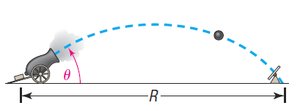
The range \( R \) of a projectile launched at angle \( \theta \) with initial velocity \( v_0 \) is given by:
\( R = \frac{v_0^2 \sin 2\theta}{g} \), where \( g \) is the acceleration due to gravity.
The maximum range occurs when \( \theta = 45^\circ \).
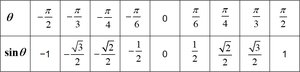
Summary Table: Common Sine Values
\( \theta \) | \( \sin \theta \) |
|---|---|
\( -\frac{\pi}{2} \) | -1 |
\( -\frac{\pi}{3} \) | \( -\frac{\sqrt{3}}{2} \) |
\( -\frac{\pi}{4} \) | \( -\frac{\sqrt{2}}{2} \) |
\( -\frac{\pi}{6} \) | -1/2 |
0 | 0 |
\( \frac{\pi}{6} \) | 1/2 |
\( \frac{\pi}{4} \) | \( \frac{\sqrt{2}}{2} \) |
\( \frac{\pi}{3} \) | \( \frac{\sqrt{3}}{2} \) |
\( \frac{\pi}{2} \) | 1 |
Additional info: These notes cover the main concepts, properties, and applications of analytic trigonometry, including inverse functions, identities, and equations, as well as their graphical representations and calculator usage. All images included are directly relevant to the explanation of the adjacent paragraphs.
