 Back
BackAnalytic Trigonometry: Inverse Functions, Fundamental Identities, and Trigonometric Equations
Study Guide - Smart Notes
 Tailored notes based on your materials, expanded with key definitions, examples, and context.
Inverse Trigonometric Functions
Objectives
Evaluate and graph the inverse sine and cosine functions.
Evaluate and graph the other inverse trigonometric functions.
Evaluate the compositions of trigonometric functions.
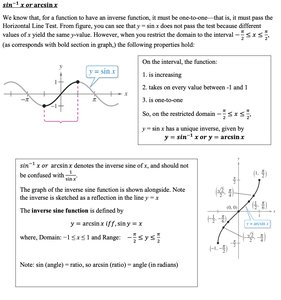
Inverse Sine Function (\( \sin^{-1} x \) or \( \arcsin x \))
The inverse sine function allows us to determine the angle whose sine is a given value. To ensure the function is one-to-one, we restrict the domain of sine to \( -\frac{\pi}{2} \leq x \leq \frac{\pi}{2} \).
Properties:
Increasing on the interval \( -\frac{\pi}{2} \leq x \leq \frac{\pi}{2} \).
Takes on every value between -1 and 1.
Is one-to-one on the restricted domain.
Notation: \( y = \sin^{-1} x \) or \( y = \arcsin x \).
Domain: \( -1 \leq x \leq 1 \), Range: \( -\frac{\pi}{2} \leq y \leq \frac{\pi}{2} \).
Inverse Cosine Function (\( \cos^{-1} x \) or \( \arccos x \))
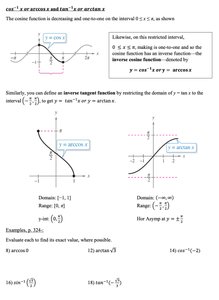
The inverse cosine function is defined by restricting the domain of cosine to \( 0 \leq x \leq \pi \), making it one-to-one.
Notation: \( y = \cos^{-1} x \) or \( y = \arccos x \).
Domain: \( -1 \leq x \leq 1 \), Range: \( 0 \leq y \leq \pi \).
Inverse Tangent Function (\( \tan^{-1} x \) or \( \arctan x \))
The inverse tangent function is defined by restricting the domain of tangent to \( -\frac{\pi}{2} < x < \frac{\pi}{2} \).
Notation: \( y = \tan^{-1} x \) or \( y = \arctan x \).
Domain: All real numbers, Range: \( -\frac{\pi}{2} < y < \frac{\pi}{2} \).
Compositions of Functions
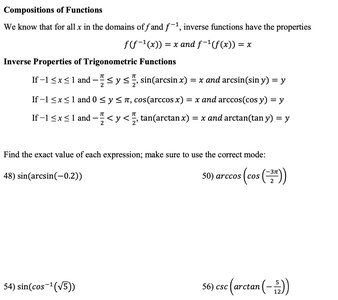
For all \( x \) in the domains of \( f \) and \( f^{-1} \), inverse functions have the properties:
\( f(f^{-1}(x)) = x \)
\( f^{-1}(f(x)) = x \)
Inverse Properties of Trigonometric Functions
If \( -1 \leq x \leq 1 \) and \( -\frac{\pi}{2} \leq y \leq \frac{\pi}{2} \), then \( \sin(\arcsin(x)) = x \) and \( \arcsin(\sin(y)) = y \).
If \( -1 \leq x \leq 1 \) and \( 0 \leq y \leq \pi \), then \( \cos(\arccos(x)) = x \) and \( \arccos(\cos(y)) = y \).
If \( x \) is real and \( -\frac{\pi}{2} < y < \frac{\pi}{2} \), then \( \tan(\arctan(x)) = x \) and \( \arctan(\tan(y)) = y \).
Fundamental Trigonometric Identities
Objectives
Recognize and write the fundamental trigonometric identities.
Use the fundamental trigonometric identities to evaluate trigonometric functions, simplify trigonometric expressions, and rewrite trigonometric expressions.
Applications of Fundamental Identities
Evaluate trigonometric functions.
Simplify trigonometric expressions.
Develop additional trigonometric identities.
Solve trigonometric equations.
Types of Fundamental Identities
Cofunction Identities: Relate trigonometric functions of complementary angles.
Ratio Identities: Express one trigonometric function in terms of another.
Reciprocal Identities: Express trigonometric functions as reciprocals of each other.
Pythagorean Identities: Relate squares of trigonometric functions.
Even/Odd Identities: Describe symmetry properties of trigonometric functions.
Trigonometric Equations and Inequalities
Objectives
Use standard algebraic techniques to solve trigonometric equations.
Solve trigonometric equations of quadratic type.
Solve trigonometric equations involving multiple angles.
Use inverse trigonometric functions to solve trigonometric equations.
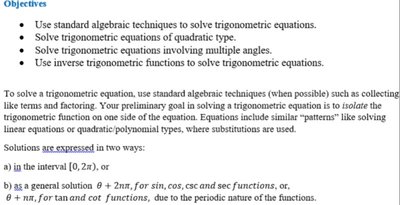
To solve a trigonometric equation, use standard algebraic techniques such as collecting like terms and factoring. The goal is to isolate the trigonometric function on one side of the equation. Solutions are expressed in two ways:
In the interval \( [0, 2\pi) \).
As a general solution \( \theta + 2\pi n \) for \( \sin, \cos, \csc \) and \( \sec \) functions, or \( \theta + \pi n \) for \( \tan \) and \( \cot \) functions, due to the periodic nature of the functions.
Unit Circle Reference
The unit circle is a fundamental tool for solving trigonometric equations and understanding the values of trigonometric functions at special angles.
Sum and Difference Identities
Formulas
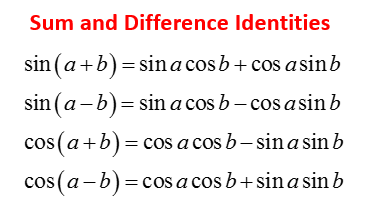
Sum and difference identities allow us to evaluate trigonometric functions involving sums or differences of angles:
\( \sin(a + b) = \sin a \cos b + \cos a \sin b \)
\( \sin(a - b) = \sin a \cos b - \cos a \sin b \)
\( \cos(a + b) = \cos a \cos b - \sin a \sin b \)
\( \cos(a - b) = \cos a \cos b + \sin a \sin b \)
Example: To find \( \sin(75^\circ) \), use the identity \( \sin(75^\circ) = \sin(45^\circ + 30^\circ) = \sin 45^\circ \cos 30^\circ + \cos 45^\circ \sin 30^\circ \).
