 Back
BackAnalytic Trigonometry: Inverse Sine, Cosine, and Tangent Functions
Study Guide - Smart Notes
 Tailored notes based on your materials, expanded with key definitions, examples, and context.
Inverse Trigonometric Functions
Introduction
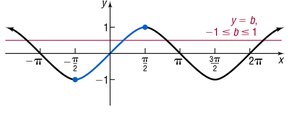
Inverse trigonometric functions are essential tools in precalculus, allowing us to determine angles when given the value of a trigonometric function. The three primary inverse trigonometric functions are the inverse sine, inverse cosine, and inverse tangent. These functions are defined with restricted domains to ensure they are one-to-one and thus have proper inverses.
Inverse Sine Function
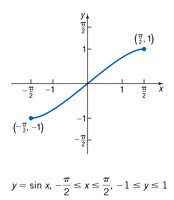
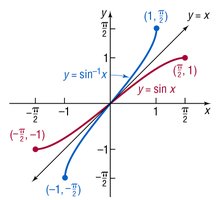
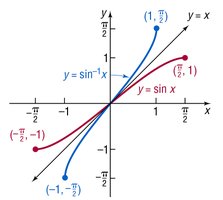
The inverse sine function, denoted as sin-1x or arcsin x, returns the angle whose sine is x. Its domain is [-1, 1], and its range is \( \left[ -\frac{\pi}{2}, \frac{\pi}{2} \right] \).
Definition: \( y = \sin^{-1} x \) if and only if \( x = \sin y \), where \( -1 \leq x \leq 1 \) and \( -\frac{\pi}{2} \leq y \leq \frac{\pi}{2} \).
Graph: The graph of \( y = \sin x \) is restricted to \( x \in \left[ -\frac{\pi}{2}, \frac{\pi}{2} \right] \) for the inverse to exist.
Example: \( \sin^{-1}(-1) = -\frac{\pi}{2} \) because \( \sin\left(-\frac{\pi}{2}\right) = -1 \).

Reference Table for Sine Values
This table is used to find exact values for inverse sine functions.
\( \theta \) | \( \sin \theta \) |
|---|---|
\( -\frac{\pi}{2} \) | -1 |
\( -\frac{\pi}{3} \) | \( -\frac{\sqrt{3}}{2} \) |
\( -\frac{\pi}{4} \) | \( -\frac{\sqrt{2}}{2} \) |
\( -\frac{\pi}{6} \) | \( -\frac{1}{2} \) |
0 | 0 |
\( \frac{\pi}{6} \) | \( \frac{1}{2} \) |
\( \frac{\pi}{4} \) | \( \frac{\sqrt{2}}{2} \) |
\( \frac{\pi}{3} \) | \( \frac{\sqrt{3}}{2} \) |
\( \frac{\pi}{2} \) | 1 |

Calculator Example
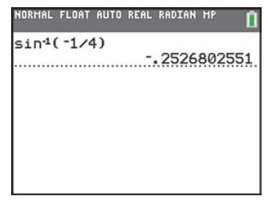
To find approximate values, use a calculator in radian mode. For example, \( \sin^{-1}\left(-\frac{1}{4}\right) \approx -0.25 \) radians.
Inverse Cosine Function
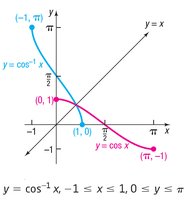
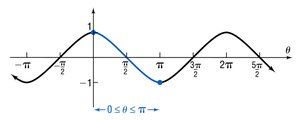
The inverse cosine function, denoted as cos-1x or arccos x, returns the angle whose cosine is x. Its domain is [-1, 1], and its range is \( [0, \pi] \).
Definition: \( y = \cos^{-1} x \) if and only if \( x = \cos y \), where \( -1 \leq x \leq 1 \) and \( 0 \leq y \leq \pi \).
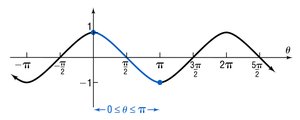
Graph: The graph of \( y = \cos x \) is restricted to \( x \in [0, \pi] \) for the inverse to exist.
Example: \( \cos^{-1}(1) = 0 \) because \( \cos(0) = 1 \).
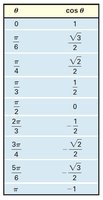
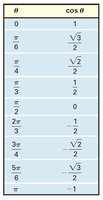
Reference Table for Cosine Values
\( \theta \) | \( \cos \theta \) |
|---|---|
0 | 1 |
\( \frac{\pi}{6} \) | \( \frac{\sqrt{3}}{2} \) |
\( \frac{\pi}{4} \) | \( \frac{\sqrt{2}}{2} \) |
\( \frac{\pi}{3} \) | \( \frac{1}{2} \) |
\( \frac{\pi}{2} \) | 0 |
\( \frac{2\pi}{3} \) | \( -\frac{1}{2} \) |
\( \frac{3\pi}{4} \) | \( -\frac{\sqrt{2}}{2} \) |
\( \frac{5\pi}{6} \) | \( -\frac{\sqrt{3}}{2} \) |
\( \pi \) | -1 |
Inverse Tangent Function
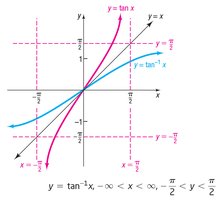
The inverse tangent function, denoted as tan-1x or arctan x, returns the angle whose tangent is x. Its domain is all real numbers, and its range is \( \left( -\frac{\pi}{2}, \frac{\pi}{2} \right) \).
Definition: \( y = \tan^{-1} x \) if and only if \( x = \tan y \), where \( -\infty < x < \infty \) and \( -\frac{\pi}{2} < y < \frac{\pi}{2} \).
Graph: The graph of \( y = \tan x \) is restricted to \( x \in \left( -\frac{\pi}{2}, \frac{\pi}{2} \right) \) for the inverse to exist.
Example: \( \tan^{-1}(1) = \frac{\pi}{4} \) because \( \tan\left(\frac{\pi}{4}\right) = 1 \).
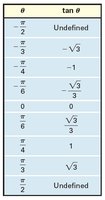
Reference Table for Tangent Values
\( \theta \) | \( \tan \theta \) |
|---|---|
\( -\frac{\pi}{2} \) | Undefined |
\( -\frac{\pi}{3} \) | \( -\sqrt{3} \) |
\( -\frac{\pi}{4} \) | -1 |
\( -\frac{\pi}{6} \) | \( -\frac{1}{\sqrt{3}} \) |
0 | 0 |
\( \frac{\pi}{6} \) | \( \frac{1}{\sqrt{3}} \) |
\( \frac{\pi}{4} \) | 1 |
\( \frac{\pi}{3} \) | \( \sqrt{3} \) |
\( \frac{\pi}{2} \) | Undefined |
Properties of Inverse Functions
Inverse trigonometric functions have important properties that relate them to their original trigonometric functions:
\( f^{-1}(f(x)) = \sin^{-1}(\sin x) = x \) where \( -\frac{\pi}{2} \leq x \leq \frac{\pi}{2} \)
\( f(f^{-1}(x)) = \sin(\sin^{-1} x) = x \) where \( -1 \leq x \leq 1 \)
\( f^{-1}(f(x)) = \cos^{-1}(\cos x) = x \) where \( 0 \leq x \leq \pi \)
\( f(f^{-1}(x)) = \cos(\cos^{-1} x) = x \) where \( -1 \leq x \leq 1 \)
\( f^{-1}(f(x)) = \tan^{-1}(\tan x) = x \) where \( -\frac{\pi}{2} < x < \frac{\pi}{2} \)
\( f(f^{-1}(x)) = \tan(\tan^{-1} x) = x \) where \( -\infty < x < \infty \)
Solving Equations Involving Inverse Trigonometric Functions
To solve equations involving inverse trigonometric functions, isolate the inverse function and use its definition to find the solution.
Example: Solve \( 12\sin^{-1}x = 3\pi \). Divide both sides by 12: \( \sin^{-1}x = \frac{\pi}{4} \). Thus, \( x = \sin\left(\frac{\pi}{4}\right) = \frac{\sqrt{2}}{2} \).
Finding the Inverse Function of a Trigonometric Function
To find the inverse of a function such as \( f(x) = 2\sin x - 1 \), follow these steps:
Replace \( f(x) \) with \( y \): \( y = 2\sin x - 1 \).
Interchange x and y: \( x = 2\sin y - 1 \).
Solve for y: \( x + 1 = 2\sin y \) \( \Rightarrow \sin y = \frac{x+1}{2} \) \( \Rightarrow y = \sin^{-1}\left(\frac{x+1}{2}\right) \).
The domain and range of the inverse function are determined by the domain of the original function and the range of the inverse sine function.
Composite Functions and Domain Restrictions
Composite functions involving inverse trigonometric functions must respect domain restrictions. For example, \( \sin(\sin^{-1}x) = x \) only if \( x \in [-1, 1] \). If the input is outside the domain, the function is not defined.
Summary Table: Domains and Ranges of Inverse Trigonometric Functions
Function | Domain | Range |
|---|---|---|
\( \sin^{-1}x \) | \( -1 \leq x \leq 1 \) | \( -\frac{\pi}{2} \leq y \leq \frac{\pi}{2} \) |
\( \cos^{-1}x \) | \( -1 \leq x \leq 1 \) | \( 0 \leq y \leq \pi \) |
\( \tan^{-1}x \) | All real numbers | \( -\frac{\pi}{2} < y < \frac{\pi}{2} \) |
Applications
Inverse trigonometric functions are used to solve equations for unknown angles in geometry, physics, and engineering.
They are essential for finding exact values and for working with composite functions.
