 Back
BackAnalytic Trigonometry: Trigonometric Identities and Algebraic Techniques
Study Guide - Smart Notes
 Tailored notes based on your materials, expanded with key definitions, examples, and context.
Analytic Trigonometry
Trigonometric Identities
Trigonometric identities are fundamental equations involving trigonometric functions that are true for all values of the variable for which the functions are defined. These identities are essential tools in simplifying expressions and solving equations in precalculus and beyond.
Definition of Identity
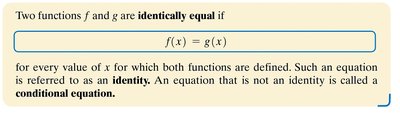
An identity is an equation that holds for every value of the variable for which both sides are defined. If two functions f and g are identically equal, then:
for all values of x in the domain. An equation that is not an identity is called a conditional equation.
Types of Trigonometric Identities
Several classes of trigonometric identities are commonly used in precalculus:
Quotient Identities: Express tangent and cotangent in terms of sine and cosine.
Reciprocal Identities: Express each trigonometric function as the reciprocal of another.
Pythagorean Identities: Relate the squares of sine, cosine, tangent, and secant.
Even–Odd Identities: Describe how trigonometric functions behave under negation of their argument.
Quotient and Reciprocal Identities
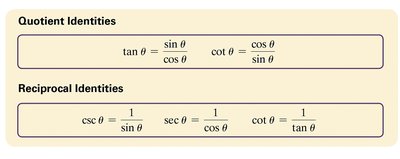
These identities allow the conversion between different trigonometric functions:
Quotient Identities:
Reciprocal Identities:
Pythagorean and Even–Odd Identities
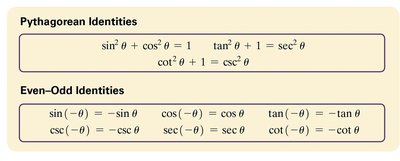
Pythagorean identities are derived from the Pythagorean theorem and are useful for simplifying expressions:
Even–Odd identities describe the symmetry properties of trigonometric functions:
Algebraic Techniques for Simplifying Trigonometric Expressions
To simplify trigonometric expressions and establish identities, several algebraic techniques are commonly used:
Rewriting in terms of sine and cosine: Express all trigonometric functions using only sine and cosine.
Multiplying by a well-chosen 1: Multiply numerator and denominator by a form of 1 (such as ) to facilitate simplification.
Combining ratios: Write sums or differences of trigonometric ratios as a single ratio.
Factoring: Factor expressions to reveal simplifications or cancellations.
Examples of Simplifying Trigonometric Expressions
Here are some examples illustrating the use of algebraic techniques:
Example 1: Simplify by rewriting in terms of sine and cosine:
So
Example 2: Show that by multiplying numerator and denominator by :
So
Example 3: Simplify by factoring:
Establishing Trigonometric Identities
To prove that two expressions are identically equal, start with the more complicated side and use algebraic techniques and known identities to transform it into the simpler side. Common strategies include:
Rewrite sums or differences of quotients as a single quotient.
Express all functions in terms of sine and cosine.
Apply Pythagorean, reciprocal, and even–odd identities as needed.
Factor and simplify expressions to reach the desired form.
Guidelines for Establishing Identities
Start with the side containing the more complicated expression.
Rewrite sums or differences of quotients as a single quotient.
Express one side in terms of sine and cosine functions only, if helpful.
Keep the goal in mind and manipulate one side to match the other.
Summary Table: Common Trigonometric Identities
Identity Type | Formulas |
|---|---|
Quotient | , |
Reciprocal | , , |
Pythagorean | , , |
Even–Odd | , , |
