 Back
BackAnalyzing One-to-One Functions and Their Inverses Using Graphs
Study Guide - Smart Notes
 Tailored notes based on your materials, expanded with key definitions, examples, and context.
Q4. (a) For each function, determine whether it is one-to-one. (b) The graph of a function is given. Draw the graph of its inverse.
Background
Topic: One-to-One Functions and Inverses
This question tests your understanding of how to determine if a function is one-to-one (injective) by analyzing its graph, and how to sketch the graph of its inverse. A function is one-to-one if every horizontal line intersects the graph at most once. The graph of the inverse function is a reflection of the original function across the line .
Key Terms and Concepts:
One-to-One Function: A function is one-to-one if implies .
Horizontal Line Test: If every horizontal line intersects the graph of at most once, then $f$ is one-to-one.
Inverse Function: The inverse of satisfies and .
Graph of the Inverse: Reflect the graph of across the line to obtain the graph of .
Step-by-Step Guidance
For each graph, apply the horizontal line test to determine if the function is one-to-one. Imagine or draw horizontal lines and see if any line crosses the graph more than once.
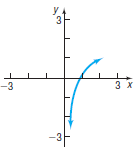
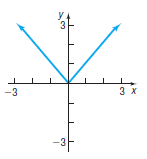
If a graph passes the horizontal line test (no horizontal line crosses more than once), the function is one-to-one. If any horizontal line crosses more than once, it is not one-to-one.
For part (b), to draw the graph of the inverse, reflect each point of the original function across the line . For example, a point on the original graph becomes on the inverse.
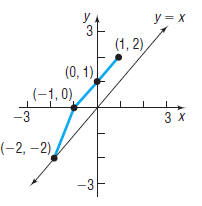
Check that the reflected graph is still a function (passes the vertical line test) and matches the expected behavior of an inverse.
Try solving on your own before revealing the answer!
