 Back
BackAnalyzing Polynomial Zeros and Intervals of Positivity/Negativity
Study Guide - Smart Notes
 Tailored notes based on your materials, expanded with key definitions, examples, and context.
Q: For a polynomial function, how do you determine the intervals where the function is positive or negative?
Background
Topic: Polynomial Functions – Zeros and Sign Analysis
This question is testing your ability to analyze a polynomial function by finding its zeros and determining on which intervals the function is positive or negative. This is a key skill in precalculus for understanding the behavior of polynomial graphs.
Key Terms and Formulas
Zero of a function: A value of where .
Interval: A range of -values between zeros (or extending to infinity).
Test value: A value chosen within an interval to determine the sign of .
Sign of : Whether is positive or negative in that interval.
Step-by-Step Guidance
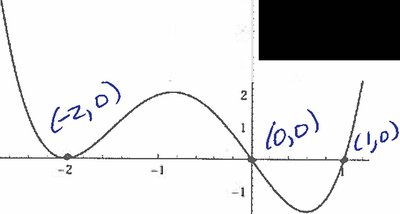
Find all the real zeros of the polynomial function . These are the -values where .
Write the intervals determined by these zeros. For example, if the zeros are , , and , the intervals will be , , , and .
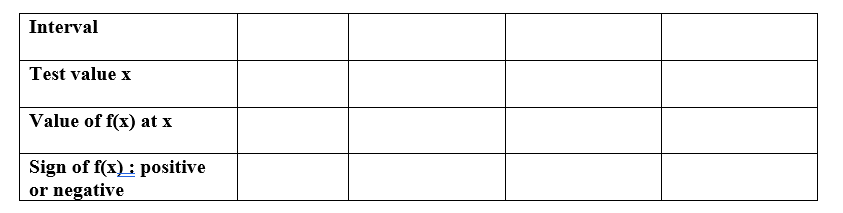
Choose a test value within each interval. Substitute this value into to determine whether $f(x)$ is positive or negative in that interval.
Record the sign of for each interval in a table like the one shown above. This helps you visualize where the function is above or below the -axis.
Try solving on your own before revealing the answer!
Final Answer:
After finding the zeros and testing values in each interval, you can fill out the table to show where is positive or negative. For example, if the zeros are , $0, the intervals are , , , and , and you would test values like , , , and $2$ in each interval.
The sign of in each interval tells you where the graph is above or below the -axis.
