 Back
BackAnalyzing the Domain, Range, and Behavior of a Piecewise Function from Its Graph
Study Guide - Smart Notes
 Tailored notes based on your materials, expanded with key definitions, examples, and context.
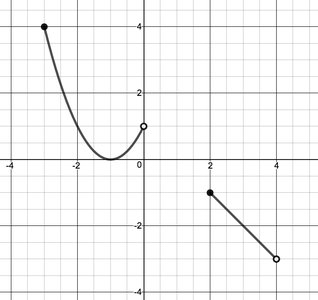
Q2. For the graph shown, answer the following:
(a) Find the domain.
(b) Find the range.
(c) Find the intervals on which the function is increasing and decreasing.
(d) Find the absolute maximum point(s), if any.
(e) Find the absolute minimum point(s), if any.
Background
Topic: Piecewise Functions and Graph Analysis
This question tests your ability to interpret a graph, determine the domain and range, and analyze where the function increases or decreases, as well as identify absolute extrema (maximum and minimum points).
Key Terms and Concepts
Domain: The set of all possible input values () for which the function is defined.
Range: The set of all possible output values () the function can take.
Increasing Interval: Where the function's output rises as increases.
Decreasing Interval: Where the function's output falls as increases.
Absolute Maximum/Minimum: The highest/lowest point on the graph over the entire domain.
Open/Closed Circles: An open circle means the endpoint is not included; a closed circle means it is included.
Step-by-Step Guidance
Examine the graph to identify the -values where the function is defined. Pay attention to open and closed circles, which indicate whether endpoints are included in the domain.
Look at the -values the graph attains to determine the range. Consider the lowest and highest points, and note if any values are excluded due to open circles.
Observe the direction of the graph as increases to find intervals where the function is increasing (moving upward) and decreasing (moving downward).
Identify the highest point(s) on the graph for the absolute maximum, and the lowest point(s) for the absolute minimum. Check if these points are included in the graph (closed circles).
Try solving on your own before revealing the answer!
