 Back
BackAngles and Radian Measure: Foundations of Trigonometry
Study Guide - Smart Notes
 Tailored notes based on your materials, expanded with key definitions, examples, and context.
Angles and Their Measurement
Definition of an Angle
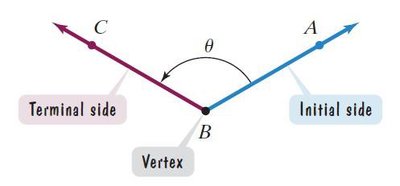
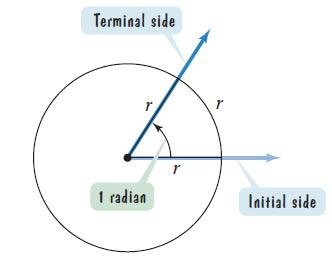
An angle is formed by two rays that share a common endpoint, called the vertex. The ray from which the angle begins is called the initial side, and the ray where the angle ends is called the terminal side.
Vertex: The common endpoint of the two rays.
Initial Side: The starting position of the ray.
Terminal Side: The position of the ray after rotation.
Angles in Standard Position
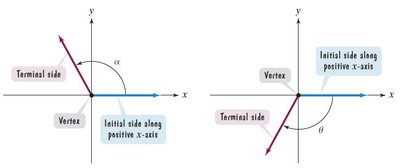
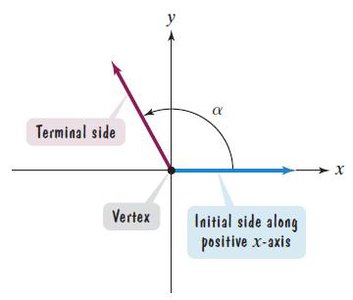
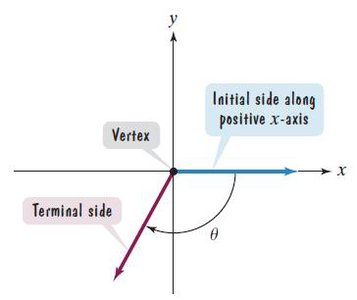
An angle is said to be in standard position if its vertex is at the origin of a rectangular coordinate system and its initial side lies along the positive x-axis. The terminal side is then rotated from the initial side to form the angle.
Positive and Negative Angles
Angles can be generated by rotating the terminal side from the initial side:
Positive angles are generated by counterclockwise rotation.
Negative angles are generated by clockwise rotation.
Quadrantal Angles
A quadrantal angle is an angle whose terminal side lies on either the x-axis or the y-axis. These angles are important reference points in trigonometry.
Measuring Angles: Degrees and Radians
Degree Measure
The degree is a common unit for measuring angles. A full rotation around a point is 360 degrees (360°).
Acute angle: Less than 90°
Right angle: Exactly 90°
Obtuse angle: Greater than 90° but less than 180°
Straight angle: Exactly 180°
Radian Measure
The radian is the standard unit of angular measure in mathematics. One radian is the measure of a central angle that intercepts an arc equal in length to the radius of the circle.
For a central angle θ in a circle of radius r that intercepts an arc of length s:
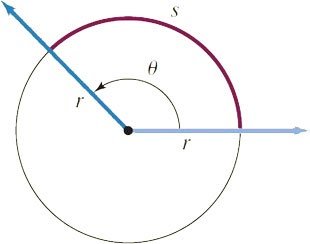
Example: Computing Radian Measure
If a central angle in a circle of radius 12 feet intercepts an arc of 42 feet, then:
Conversion Between Degrees and Radians
The relationship between degrees and radians is:
To convert degrees to radians:
To convert radians to degrees:
Examples: Degree-Radian Conversion
Convert to radians: radians
Convert radians to degrees:
Drawing Angles in Standard Position
Angles can be visualized by rotating the terminal side from the initial side. The amount of rotation can be described in terms of fractions of a revolution, degrees, or radians.
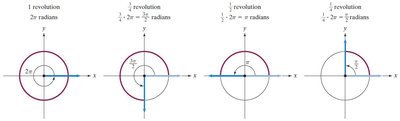
Examples: Drawing Angles
To draw , rotate the terminal side clockwise by of a revolution.
To draw , rotate the terminal side counterclockwise by of a revolution.
To draw , rotate the terminal side clockwise by of a revolution.
To draw , rotate the terminal side counterclockwise by of a revolution.
Common Angles in Trigonometry
Angles commonly used in trigonometry are often expressed in both degrees and radians. The following tables summarize these relationships:
Terminal Side | Radian Measure of Angle | Degree Measure of Angle |
|---|---|---|
revolution | ||
revolution | ||
revolution | ||
revolution | ||
revolution |
Terminal Side | Radian Measure of Angle | Degree Measure of Angle |
|---|---|---|
revolution | ||
revolution | ||
revolution | ||
revolution | ||
1 revolution |
Coterminal Angles
Definition and Properties
Coterminal angles are angles in standard position that share the same initial and terminal sides but may have different measures due to additional full rotations.
In degrees: is coterminal with , where is any integer.
In radians: is coterminal with , where is any integer.
Examples: Finding Coterminal Angles
A 400° angle: (coterminal angle less than 360°)
A -135° angle: (coterminal angle less than 360°)
A angle: (coterminal angle less than )
Arc Length and Circular Motion
Length of a Circular Arc
The length of an arc, , intercepted by a central angle (in radians) in a circle of radius is given by:
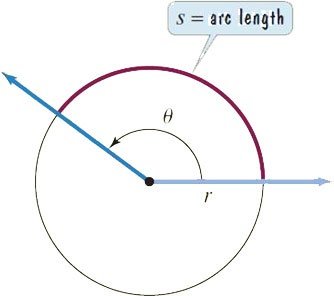
Example: Finding Arc Length
For a circle of radius 6 inches and a central angle of :
Convert to radians:
Arc length: inches
Linear and Angular Speed
If a point moves along a circle of radius through an angle (in radians) in time :
Linear speed: , where
Angular speed:
Relationship:
Example: A 45-rpm record (angular speed radians/min) with a needle 1.5 inches from the center has linear speed in/min.
Additional info: These concepts form the foundation for understanding trigonometric functions, circular motion, and applications in physics and engineering.
