 Back
BackAngles and Radian Measure – Foundations of Trigonometric Functions
Study Guide - Smart Notes
 Tailored notes based on your materials, expanded with key definitions, examples, and context.
Chapter 4: Trigonometric Functions
4.1 Angles and Radian Measure
This section introduces the foundational concepts of angles, their measurement in degrees and radians, and their geometric representation. Understanding these concepts is essential for further study in trigonometry and precalculus.
Angles: Definitions and Terminology
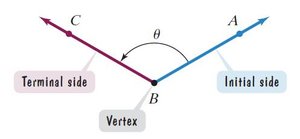
Angle: Formed by two rays (the sides of the angle) sharing a common endpoint called the vertex.
Initial Side: The starting position of the ray.
Terminal Side: The position of the ray after rotation.
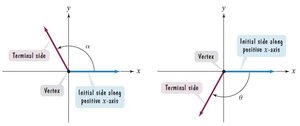
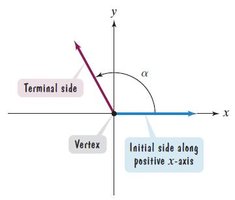
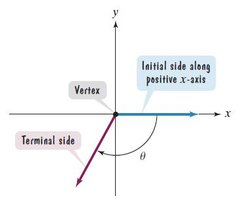
Standard Position: An angle is in standard position if its vertex is at the origin of a rectangular coordinate system and its initial side lies along the positive x-axis.
Measuring Angles Using Degrees
Degree: A unit of angle measure. One complete rotation is 360 degrees (360°).
Acute Angle: Measures less than 90°.
Right Angle: Measures exactly 90°.
Obtuse Angle: Measures more than 90° but less than 180°.
Straight Angle: Measures exactly 180°.
Measuring Angles Using Radians
A radian is another unit for measuring angles, commonly used in mathematics and science. It relates the angle to the radius and arc length of a circle.
Central Angle: An angle whose vertex is at the center of a circle.
Radian: The measure of a central angle that intercepts an arc equal in length to the radius of the circle.
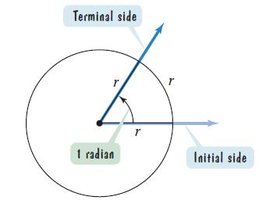
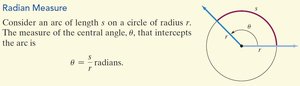
Radian Measure Formula
The radian measure of a central angle θ that intercepts an arc of length s on a circle of radius r is given by:
Conversion Between Degrees and Radians
To convert between degrees and radians, use the following relationships:
radians
To convert degrees to radians:
To convert radians to degrees:
Example: Convert 60° to radians:
radians
Example: Convert radians to degrees:
Drawing Angles in Standard Position
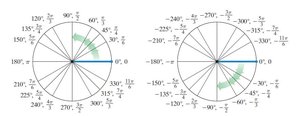
Angles can be drawn in standard position on the coordinate plane. Positive angles are generated by counterclockwise rotation, while negative angles are generated by clockwise rotation.
Degree and Radian Measures of Common Angles
Many angles frequently used in trigonometry have well-known degree and radian measures. The following table summarizes these values:
Degree Measure | Radian Measure |
|---|---|
0° | 0 |
30° | |
45° | |
60° | |
90° | |
120° | |
135° | |
150° | |
180° | |
210° | |
225° | |
240° | |
270° | |
300° | |
315° | |
330° | |
360° |
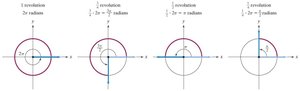
Revolutions and Radian Measure
One complete revolution around a circle corresponds to radians. Fractions of a revolution can be expressed in radians as well:
1 revolution = radians
revolution = radians
revolution = radians
revolution = radians


Coterminal Angles
Coterminal angles are angles in standard position that share the same initial and terminal sides but may have different measures. To find coterminal angles, add or subtract multiples of 360° (or radians):
In degrees:
In radians:
where is any integer.
Example: Find a positive angle less than 360° coterminal with 400°:
Example: Find a positive angle less than 360° coterminal with –135°:
Length of a Circular Arc
The length of an arc (s) intercepted by a central angle θ (in radians) in a circle of radius r is given by:
Linear and Angular Speed
Angular Speed (ω): The rate at which the central angle changes, measured in radians per unit time.
Linear Speed (v): The rate at which a point moves along the circumference, given by .
Example: If a wheel of radius 0.5 m rotates at 4 radians per second, the linear speed at the rim is:
m/s
