 Back
BackAngles, Arc Length, and Circular Motion – Precalculus Chapter 5 Study Notes
Study Guide - Smart Notes
 Tailored notes based on your materials, expanded with key definitions, examples, and context.
Trigonometric Functions
Section 5.1: Angles, Arc Length, and Circular Motion
This section introduces foundational concepts in trigonometry, focusing on angles, their measurement, and applications involving circles. Understanding these concepts is essential for further study in trigonometric functions and their real-world applications.
Angles and Degree Measure
Definition of an Angle
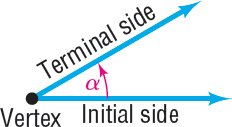
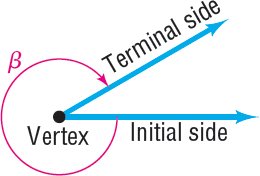
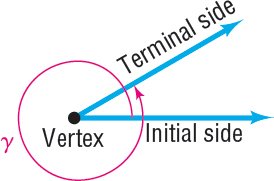
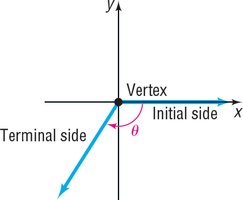
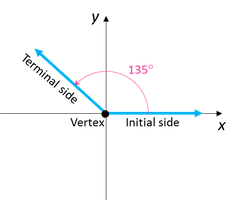
An angle is formed by two rays sharing a common endpoint called the vertex. The ray that remains fixed is the initial side, and the ray that rotates is the terminal side.
Positive angles are generated by counterclockwise rotation from the initial side to the terminal side.
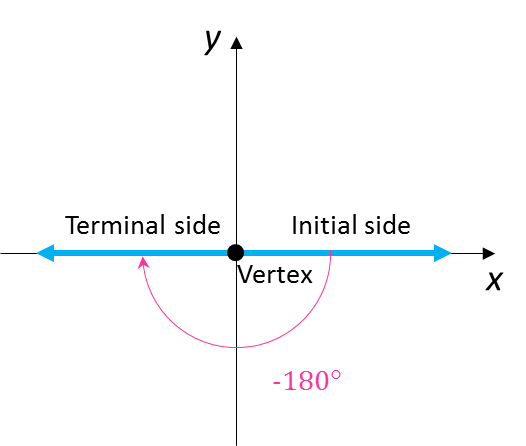
Negative angles are generated by clockwise rotation.
Standard Position of an Angle
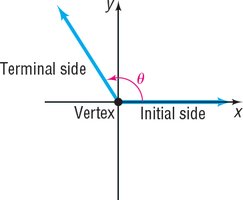
An angle is in standard position if its vertex is at the origin of a rectangular coordinate system and its initial side lies along the positive x-axis.
If the terminal side is above the x-axis, the angle is positive.
If the terminal side is below the x-axis, the angle is negative.
Quadrants and Quadrantal Angles
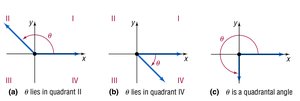
When an angle is in standard position, its terminal side may lie in one of the four quadrants or on the x- or y-axis. If it lies on an axis, it is called a quadrantal angle.
Quadrant I: 0° < θ < 90°
Quadrant II: 90° < θ < 180°
Quadrant III: 180° < θ < 270°
Quadrant IV: 270° < θ < 360°
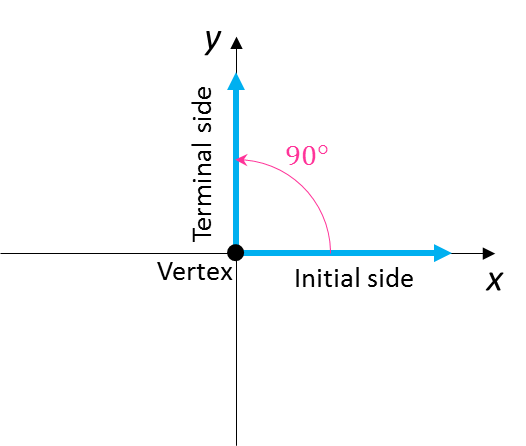
Quadrantal angles: θ = 0°, 90°, 180°, 270°, 360°
Degree Measure
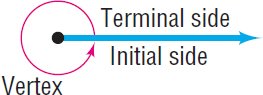
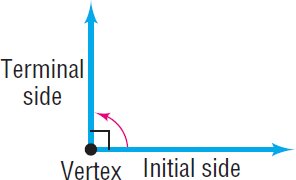
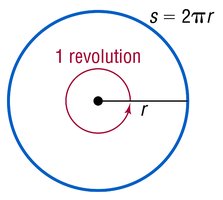
The degree is a unit for measuring angles. One full revolution (counterclockwise) is 360°, a right angle is 90°, and a straight angle is 180°.
1 revolution = 360°
Right angle = 90°
Straight angle = 180°

Examples: Drawing Angles in Standard Position
135°: Lies in Quadrant II.
−180°: Clockwise rotation, straight angle.
90°: Counterclockwise, right angle.
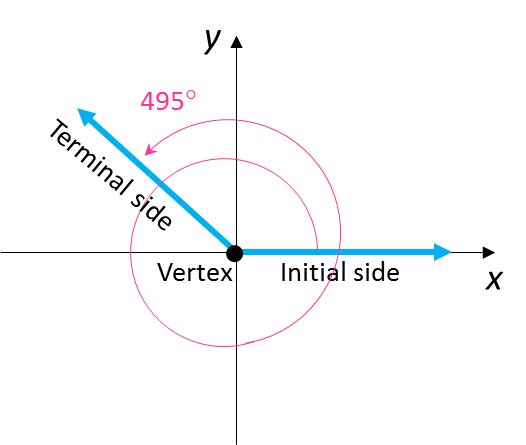
495°: Equivalent to 135° (495° − 360° = 135°).
Convert Between Decimal and Degree, Minute, Second Measures for Angles
Minutes and Seconds
Angles can be measured in degrees, minutes, and seconds:
1 degree (1°) = 60 minutes (60')
1 minute (1') = 60 seconds (60")
1 second (1") = 1/60 minute = 1/3600 degree
Example: 30° 40' 10" is written as 30 degrees, 40 minutes, 10 seconds.
Converting Between Decimal and DMS
To convert DMS to decimal degrees:
To convert decimal degrees to DMS: Multiply the decimal part by 60 for minutes, then the decimal part of minutes by 60 for seconds.
Radians
Definition of a Radian
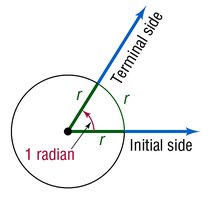
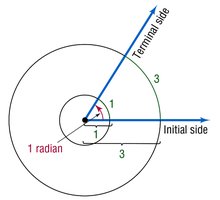
A radian is the measure of a central angle whose arc length equals the radius of the circle. Radians are the standard unit for measuring angles in mathematics.
For a circle of radius r, an angle of 1 radian subtends an arc of length r.
Find the Length of an Arc of a Circle
Arc Length Formula
The length s of an arc of a circle of radius r subtended by a central angle of θ radians is given by:
Example: For a circle of radius 4 meters and a central angle of 0.75 radians:
meters
Convert from Degrees to Radians and from Radians to Degrees
Conversion Formulas
To convert degrees to radians:
To convert radians to degrees:
Common Angles in Degrees and Radians
Degrees | Radians |
|---|---|
30° | |
45° | |
60° | |
90° | |
180° | |
360° |

Find the Area of a Sector of a Circle
Area of a Sector Formula
The area A of a sector of a circle of radius r formed by a central angle of θ radians is:
Example: For a circle of radius 3 meters and an angle of 45° ( radians):
square meters
Find the Linear Speed of an Object Traveling in Circular Motion
Definition of Linear Speed
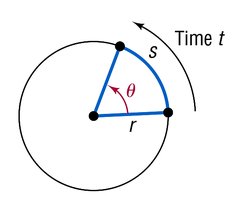
If an object moves along a circle of radius r and travels a distance s in time t, its linear speed v is:
Definition of Angular Speed
The angular speed ω is the angle θ (in radians) swept out per unit time:
Example: Finding Linear Speed
A child spins a rock at the end of a 2-foot rope at 180 revolutions per minute. The linear speed is calculated using the radius and angular speed.
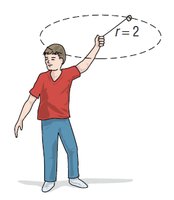
Angular speed: radians per minute
Linear speed:
Applications: Distance Between Two Cities
Using Central Angles and Arc Length
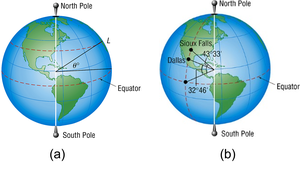
The latitude difference between two cities can be used to find the distance along Earth's surface, modeled as a circle.
Find the central angle in radians.
Use the arc length formula:
 Additional info: These notes cover all objectives listed in Section 5.1, including definitions, formulas, and examples relevant to precalculus students studying trigonometric functions and circular motion.
