 Back
Angles: Degree and Radian Measure in Precalculus
Study Guide - Smart Notes
 Tailored notes based on your materials, expanded with key definitions, examples, and context.
6.1 An Introduction to Angles: Degree and Radian Measure
Definition and Structure of Angles
An angle is formed by two rays sharing a common endpoint called the vertex. The ray that remains fixed is the initial side, and the ray that rotates is the terminal side. The direction of rotation determines the sign of the angle: counterclockwise rotation yields a positive angle, while clockwise rotation yields a negative angle.
Initial Side: The fixed ray from the vertex.
Terminal Side: The rotated ray from the vertex.
Vertex: The common endpoint of both rays.
Positive Angle: Measured counterclockwise.
Negative Angle: Measured clockwise.
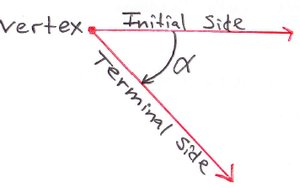
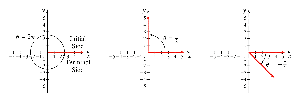
An angle is in standard position if its vertex is at the origin and its initial side lies along the positive x-axis. The terminal side can be in any quadrant or on an axis.
Quadrants and Standard Position
Angles in standard position are classified by the quadrant in which their terminal side lies. This classification is important for understanding trigonometric functions and their signs.
Quadrant I: Terminal side between 0° and 90° (or 0 and π/2 radians).
Quadrant II: Terminal side between 90° and 180° (or π/2 and π radians).
Quadrant III: Terminal side between 180° and 270° (or π and 3π/2 radians).
Quadrant IV: Terminal side between 270° and 360° (or 3π/2 and 2π radians).
Objective 1: Understanding Degree Measure
Degree Measure of Angles
The degree is a unit of angular measure. One complete revolution is 360°, and common angles include 90° (one-fourth revolution) and 45° (one-eighth revolution).
360°: One complete counterclockwise revolution.
90°: One-fourth of a counterclockwise revolution.
-45°: One-eighth of a clockwise revolution.
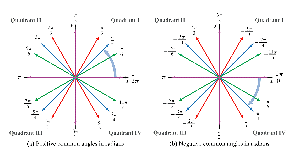
Common Positive and Negative Angles
Positive angles are measured counterclockwise, and negative angles are measured clockwise from the initial side. The following diagram shows common angles in both directions:
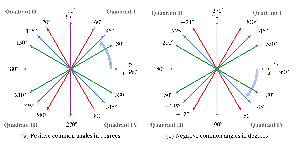
Objective 2: Finding Coterminal Angles Using Degree Measure
Coterminal Angles
Coterminal angles are angles in standard position that share the same terminal side. They can be found by adding or subtracting integer multiples of 360° to a given angle.
Formula: , where is any integer.
Example: 45°, 405°, and -315° are coterminal because and .
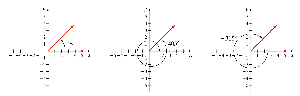
Every angle has a coterminal angle of least non-negative measure, often denoted as .
Objective 3: Understanding Radian Measure
Definition of Radian
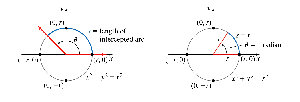
A radian is the measure of a central angle whose intercepted arc is equal in length to the radius of the circle. The relationship between degrees and radians is fundamental in trigonometry.
1 radian: The angle subtended by an arc equal to the radius.
Formula: , where is arc length and is radius.
Relationship: radians
Common Angles in Radians
Just as with degrees, common angles in radians are used frequently in trigonometry:
radians: One complete revolution (360°)
radians: One-fourth revolution (90°)
radians: One-eighth clockwise revolution (-45°)
Common Positive and Negative Angles in Radians
Positive angles are measured counterclockwise, negative angles clockwise. The following diagram shows common angles in radians:
Objective 4: Converting Between Degree Measure and Radian Measure
Conversion Formulas
To convert between degrees and radians, use the following formulas:
Degrees to Radians:
Radians to Degrees:
Example: Convert 90° to radians: radians.
Example: Convert radians to degrees: .
Objective 5: Finding Coterminal Angles Using Radian Measure
Coterminal Angles in Radians
Coterminal angles in radians are found by adding or subtracting integer multiples of to a given angle.
Formula: , where is any integer.
Example: , , , and are coterminal.
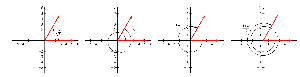
Every angle has a coterminal angle of least non-negative measure, denoted as .
