 Back
BackAngles, Radian Measure, and Applications of Circular Motion
Study Guide - Smart Notes
 Tailored notes based on your materials, expanded with key definitions, examples, and context.
Angles and Radian Measure
Definition of an Angle
An angle is formed by rotating a ray (the initial side) about its endpoint to a new position (the terminal side). The amount of rotation is measured in degrees or radians.
Degree: A traditional unit for measuring angles. One full revolution is 360°.
Radian: The standard unit of angular measure in mathematics. One radian is the angle subtended at the center of a circle by an arc whose length is equal to the radius of the circle.
Formula for radian measure:
Where is the angle in radians, is the arc length, and is the radius.
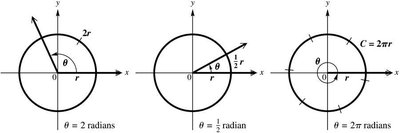
Relationship Between Degrees and Radians
To convert between degrees and radians:
radians
To convert degrees to radians:
To convert radians to degrees:
Applications of Radian Measure
Arc Length
The arc length of a circle subtended by a central angle (in radians) is given by:
Where is the radius of the circle and is in radians.
Sectors of a Circle
The area of a sector of a circle with radius and central angle (in radians) is:
Example: Calculating Arc Length
Given a circle with radius m and a central angle of , find the arc length.
First, convert the angle to radians: radians.
Then, use : m.
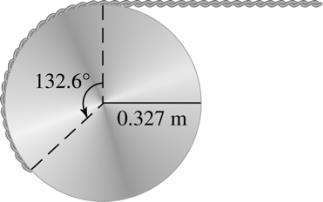
Applications: Gears and Rotational Motion
Gear Ratios and Rotational Motion
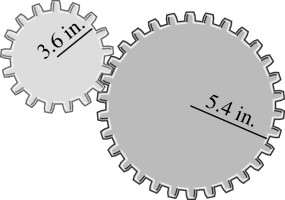
When two gears are meshed, the rotation of one gear causes the other to rotate. The number of teeth or the radius/diameter of the gears determines their relative speeds.
Gear Ratio: The ratio of the number of teeth (or radii) of two gears. If Gear A has radius and Gear B has radius , then the gear ratio is .
The angular velocity of the gears is inversely proportional to their radii: .
Example: If a small gear with radius in. meshes with a larger gear of radius in., the gear ratio is .
Additional info: These concepts are foundational for understanding trigonometric functions, circular motion, and applications in physics and engineering.
