 Back
BackApplications and Laws of Triangles in Precalculus: Right, Oblique, and Area Calculations
Study Guide - Smart Notes
 Tailored notes based on your materials, expanded with key definitions, examples, and context.
Applications Involving Right Triangles
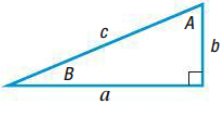
Solving Right Triangles
To solve a right triangle means to determine all unknown side lengths and angle measures. This process requires knowledge of at least one acute angle and one side, or two sides. The following principles are essential:
Angles should be measured in degrees and rounded to one decimal place.
Sides should be rounded to two decimal places.
The sum of all angles in a triangle is 180°, so the two acute angles in a right triangle must add to 90°.
The Pythagorean Theorem is used to solve for missing sides: .
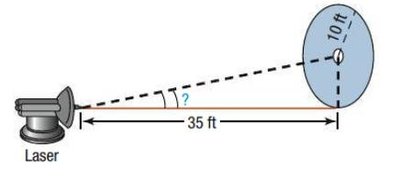
Example: Laser Beam Application
In practical applications, such as aiming a laser through a hole in a circle, right triangle trigonometry is used to determine the required angle of elevation. Given the distance from the laser to the circle and the radius, trigonometric ratios can be applied to solve for the angle.
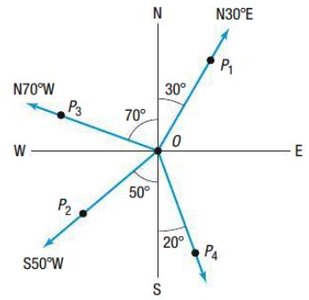
Bearings in Navigation and Surveying
Bearings are used in navigation to describe direction. The bearing from point O to point P is the acute angle between the line OP and the north-south line through O. Bearings are measured clockwise from north or south.
Examples: N30°E, S50°W, N70°W, S20°E
The Law of Sines
Oblique Triangles
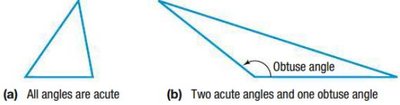
An oblique triangle is a triangle with no right angle. It can have three acute angles or two acute angles and one obtuse angle. Solving an oblique triangle involves finding unknown sides and angles using given information.
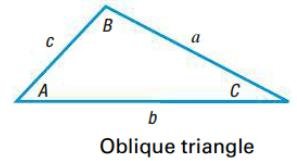
Cases for Solving Triangles
There are four main cases for solving triangles, depending on the known sides and angles:
Case 1: ASA (Angle-Side-Angle)
Case 1: SAA (Side-Angle-Angle)
Case 2: SSA (Side-Side-Angle)
Case 3: SAS (Side-Angle-Side)
Case 4: SSS (Side-Side-Side)

The Law of Sines
The Law of Sines relates the sides and angles of any triangle:
This law is especially useful for Case 1 (ASA, SAA) and Case 2 (SSA).
The Ambiguous Case (SSA)
When two sides and a non-included angle are known (SSA), there may be one, two, or no possible triangles. The key is to compare the given side to the height calculated using :
No triangle if
One right triangle if
One triangle if
Two triangles if
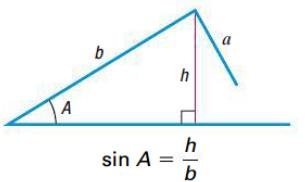
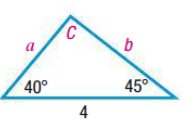
Example: Solving an Oblique Triangle
Given two angles and a side, or two sides and an angle, use the Law of Sines to solve for unknowns. Always check for the possibility of a second triangle in SSA cases by considering the supplementary angle.
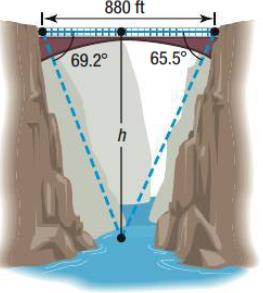
Applications of the Law of Sines
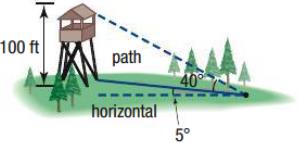
Real-world problems, such as determining the height of a bridge or the distance to a tower, can be solved using the Law of Sines when the triangle is not a right triangle.
The Law of Cosines
When to Use the Law of Cosines
The Law of Cosines is used for triangles where two sides and the included angle (SAS) or all three sides (SSS) are known. The formulas are:
When , the Law of Cosines reduces to the Pythagorean Theorem.
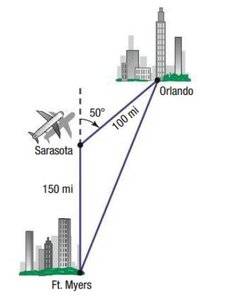
Example: Airplane Navigation
To find the direct distance between two points when the path forms a triangle, use the Law of Cosines. This is common in navigation and surveying.
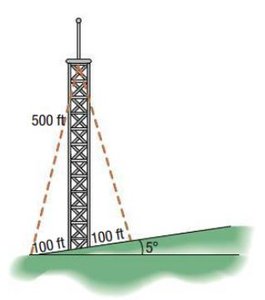
Example: Guy Wires on a Hill
When a structure is on an incline, the Law of Cosines helps determine the length of supporting wires or cables.
Area of a Triangle
Standard Area Formula
The area of a triangle is given by:
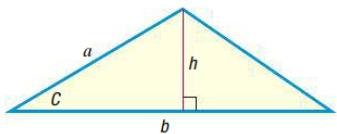
where is the base and is the height (altitude) drawn to that base.
Area Using Trigonometry
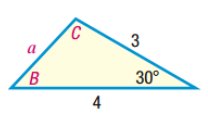
For triangles where two sides and the included angle are known (SAS), the area can be found using:
Heron's Formula (SSS Case)
If all three sides are known, use Heron's Formula:
where is the semi-perimeter.
Example: Area Calculation
Given side lengths and/or angles, apply the appropriate formula to find the area. For example, with , , and :
Summary Table: Triangle Solution Methods
Case | Known | Method |
|---|---|---|
ASA, SAA | 2 angles, 1 side | Law of Sines |
SSA | 2 sides, angle not included | Law of Sines (ambiguous case) |
SAS | 2 sides, included angle | Law of Cosines |
SSS | 3 sides | Law of Cosines, Heron's Formula |
