 Back
BackApplications of Right Triangles and Trigonometric Functions
Study Guide - Smart Notes
 Tailored notes based on your materials, expanded with key definitions, examples, and context.
Section 6.2 Applications of Right Triangles
Solving Right Triangles
To solve a right triangle means to find the lengths of all sides and the measures of all angles. This process uses the relationships between the sides and angles, often applying trigonometric functions such as sine, cosine, and tangent.
Key Terms: In a right triangle, the side opposite the right angle is called the hypotenuse. The other two sides are called legs.
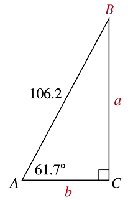
Standard Notation: Side a is opposite angle A, side b is opposite angle B, and side c (the hypotenuse) is opposite the right angle C.
Trigonometric Ratios:
Sine:
Cosine:
Tangent:
Example: Given a right triangle with hypotenuse 106.2 and angle 61.7°, find the lengths of the legs a and b and the measure of angle B.
Applied Problems Involving Right Triangles
Trigonometric functions are widely used to solve real-world problems involving right triangles, such as construction, navigation, and surveying.
Key Steps:
Draw and label a diagram representing the problem.
Identify known and unknown quantities.
Choose the appropriate trigonometric function based on the given information.
Solve for the unknown using algebraic manipulation and, if necessary, a calculator.
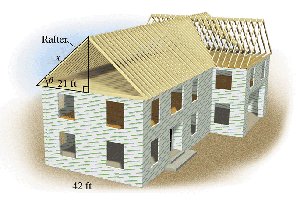
Example: Calculating the length of a rafter for a house with a given pitch and width.
Finding the Pitch and Angle
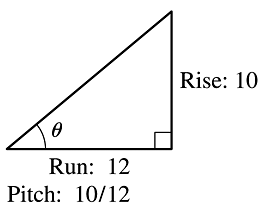
The pitch of a roof is the ratio of the rise to the run. For a rise of 10 feet and a run of 12 feet:
Pitch =
Angle can be found using the tangent function:
Solving for :
Determining the Length of the Rafter
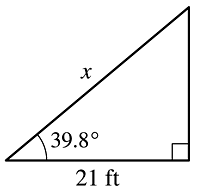
Given the width of the house is 42 feet, half the width (21 feet) forms the base of the right triangle. The length of the rafter x is found using the cosine function:
Solving for x: feet
Angles of Elevation and Depression
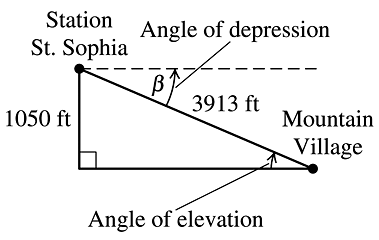
The angle of elevation is the angle between the horizontal and a line of sight above the horizontal. The angle of depression is the angle between the horizontal and a line of sight below the horizontal. These concepts are essential in solving problems involving heights and distances.
Angle of Elevation: Used when looking up at an object.
Angle of Depression: Used when looking down at an object.
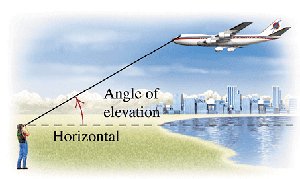
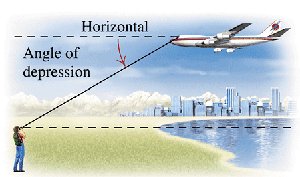
Applications: Elevation and Depression
Problems involving angles of elevation and depression often require drawing a right triangle and applying trigonometric ratios to find unknown distances or heights.
Example: Calculating the angle of elevation from a town to a mountain station and the angle of depression from the station to a village.
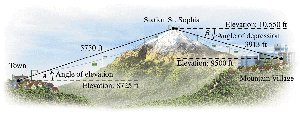
Given: Elevation difference and horizontal distance.
Angle of elevation is found using .
For example, , so
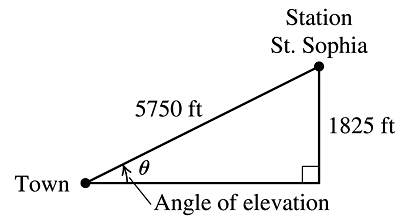
Angle of depression is calculated similarly, using the difference in elevation and the horizontal distance.
For example, , so
Bearing and Direction
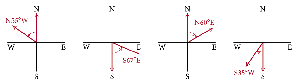
Bearing is a method of describing direction using an acute angle measured from a north-south line. Bearings are commonly used in navigation and surveying.
Examples: North 55° West (55° west of north), South 67° East (67° east of south).
Solving Applied Problems with Bearings
Problems involving bearings often require constructing a right triangle based on the given directions and distances, then applying trigonometric functions to find unknown lengths.
Example: Two forest rangers sight a fire from different locations. Given the bearing and the distance between the rangers, find the distance from one ranger to the fire.
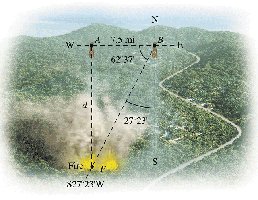
Use the tangent function: , so miles
Complex Applications: Stadium Viewing Angles
Trigonometric functions can also be used to solve more complex real-world problems, such as determining viewing distances in a stadium based on angles of depression and known distances.
Example: From the last row of a stadium, the angle of depression to home plate is 29.9°, and to the pitcher’s mound is 24.2°. The horizontal distance from home plate to the pitcher’s mound is 60.5 feet. Find the viewing distances.
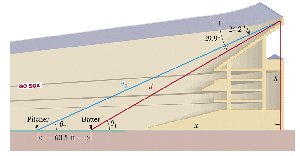
Let h be the elevation of the last row, x the horizontal distance from home plate to a point below the seat, d_1 the viewing distance to home plate, and d_2 the viewing distance to the pitcher’s mound.
Use the tangent function to find x and h:
and
Once x and h are found, use the cosine function to find the viewing distances:
,
Results: Distance to home plate ≈ 250 feet, distance to pitcher’s mound ≈ 304 feet.
