 Back
BackApplications of Right Triangles and Trigonometry: The Unit Circle and Beyond
Study Guide - Smart Notes
 Tailored notes based on your materials, expanded with key definitions, examples, and context.
9.7 Applications of Right Triangles
Significant Digits and Measurement
In trigonometric applications, most values and measurements are approximations. Significant digits represent the actual precision of a measurement, and it is important to report answers with the correct number of significant digits to reflect the accuracy of the data.
Solving a Right Triangle Given an Angle and a Side
To solve a right triangle means to find all unknown sides and angles. If one angle (other than the right angle) and one side are known, the remaining sides and angles can be found using trigonometric ratios and the fact that the sum of the angles in a triangle is 180º.
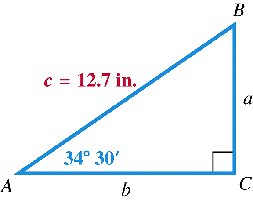
Given: Angle A = 34º 30', hypotenuse c = 12.7 in.
Find: Angle B = 90º – A = 55º 30'
Use sine, cosine, or tangent to find the other sides:
Solving a Right Triangle Given Two Sides
If two sides of a right triangle are known, the third side can be found using the Pythagorean theorem, and the angles can be found using inverse trigonometric functions.
Given: a = 29.43 cm, c = 53.58 cm
Find: Angle A using the inverse sine function:
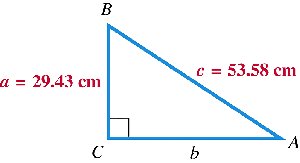
The Pythagorean theorem is used to find the third side:
Angles of Elevation and Depression
Definitions
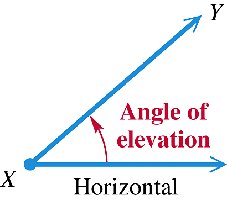
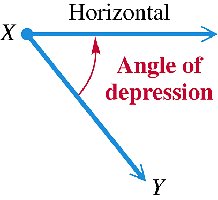
The angle of elevation is the angle formed by the line of sight upward from the horizontal to an object above. The angle of depression is the angle formed by the line of sight downward from the horizontal to an object below.
Application Example: Finding the Elevation of the Sun
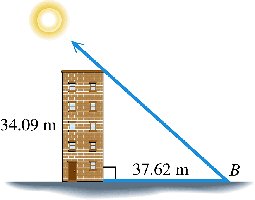
Given the height of a building and the length of its shadow, the angle of elevation of the sun can be found using the tangent function:
Given: Height = 34.09 m, Shadow = 37.62 m
Find:
Bearing and Navigation
Bearing (First Method)
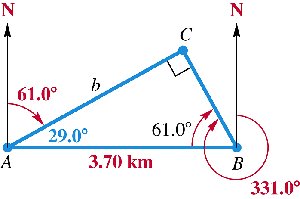
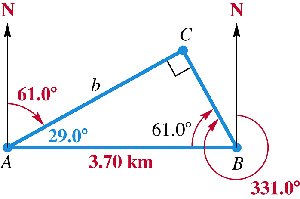
Bearing is a way to describe direction in navigation. When a single angle is given, it is measured clockwise from due north.
Solving a Problem Involving Bearing (First Method)
Given two radar stations and the bearings to a plane, the location of the plane can be determined using right triangle trigonometry and the cosine function.
Given: Stations A and B are 3.70 km apart on an east-west line. Bearings to plane C are 61.0º from A and 331.0º from B.
Draw a sketch and use trigonometric relationships to solve for the unknown distance.
Bearing (Second Method)
The second method for expressing bearing uses a north-south reference line and an acute angle east or west from this line. The format is always N or S, followed by the angle, then E or W (e.g., S 52º E).
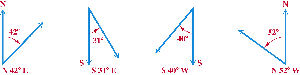
Solving a Problem Involving Bearing (Second Method)
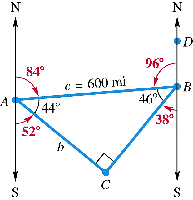
Given bearings and travel distances, the location of a point can be found using trigonometric relationships and the Law of Sines or Cosines as appropriate.
Given: Bearings from A to C (S 52º E), from A to B (N 84º E), from B to C (S 38º W), and the distance from A to B (600 mi).
Draw a sketch and use the sine function to find the unknown distance.
Airport Runway Bearings
Runway numbers are based on their bearings, rounded to the nearest 10 degrees and divided by 10. The left (L) and right (R) runways differ by 180 degrees (or 18 in runway numbering). For example, if one runway is 12L, the opposite is 30R.
Example: If the pilot turns right onto runway 30R, the bearing is 300º, indicating a northwest direction.
Parallax and Calculating the Distance to a Star
Parallax Method
Parallax is the apparent shift in position of a nearby object against a distant background when viewed from two different positions. In astronomy, the parallax angle can be used to calculate the distance to a star.
Given: Parallax angle , Earth-Sun distance
Formula: (for small angles, in radians)
Example: For Alpha Centauri, , miles
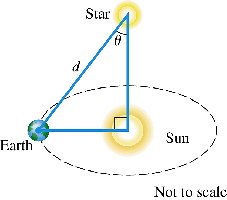
To find the distance in light-years, divide the result by the number of miles in a light-year (about 5.9 trillion miles).
Solving Problems Involving Angles of Elevation
Example: Finding the Height of a Tree
When two angles of elevation are measured from two points a known distance apart, the height of an object can be found using trigonometric equations.
Given: Angles of elevation are 36.7º and 22.2º, points are 50 ft apart.
Let: = distance from the tree to the closer point, = height of the tree
Set up equations using tangent:
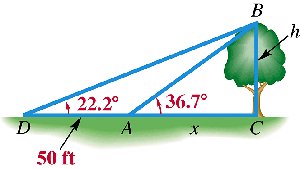
Set the two expressions for equal and solve for :
Solve for , then substitute back to find .
Graphing Calculator Solution
The equations can be graphed as lines, and their intersection gives the solution for and .
Line 1:
Line 2:
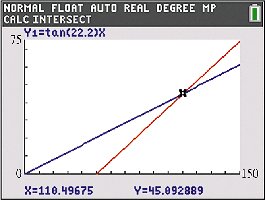
From the graph, feet.
Additional info: The above notes cover the main applications of right triangles in trigonometry, including navigation, astronomy, and practical measurement problems. All equations are provided in LaTeX format for clarity and further study.
