 Back
BackChapter 1.6: A Library of Functions – Graphs and Properties
Study Guide - Smart Notes
 Tailored notes based on your materials, expanded with key definitions, examples, and context.
Graphs and Functions
Introduction to a Library of Functions
This section introduces fundamental types of functions commonly encountered in algebra and precalculus. Understanding their definitions, properties, and graphs is essential for analyzing more complex mathematical models.
Linear Functions
Definition and Properties
Linear Function: A function of the form , where m and b are real numbers.
Constant Function: If , then is a constant function.
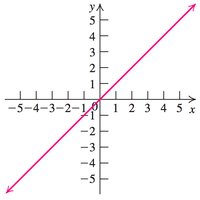
Identity Function: If and , then is the identity function.
The graph of a linear function is a nonvertical straight line with slope m and y-intercept b.
Example: Writing a Linear Function
Find a linear function such that and .
Find the slope:
Use point-slope form:
Simplify:
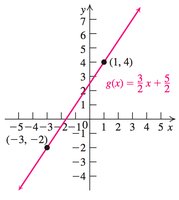
Application: Linear Models
Linear functions are used to model real-world relationships. For example, the length of a "Megatooth" shark can be estimated from tooth height:
Formula:
For a tooth of 15.6 cm: meters
Root Functions
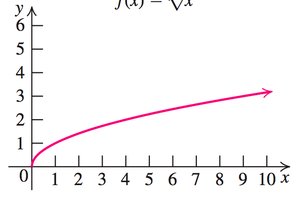
Square Root Function
Definition:
Domain:
Range:
Graph passes through points where is a perfect square.
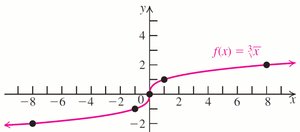
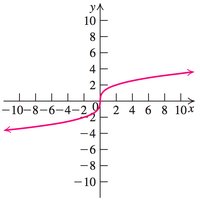
Cube Root Function
Definition:
Domain and Range:
Graph passes through points where is a perfect cube.
Piecewise Functions
Definition and Evaluation
A piecewise function uses different formulas for different parts of its domain. To evaluate, determine which formula applies to the input value.
Example:
(since )
(since )
Application: Speeding Fines as a Piecewise Function
For mph,
Fine for 60 mph:
Fine for 90 mph:
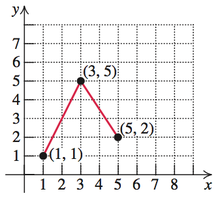
Piecewise Functions from Data
Given points (1,1), (3,5), (5,2), connect with line segments and express as a piecewise function.
Step Functions
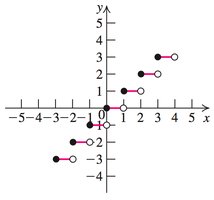
Greatest Integer Function
Definition: (the greatest integer less than or equal to )
Graph is a series of horizontal segments, jumping at each integer value.
Basic Functions and Their Properties
Summary Table of Common Functions
Function | Equation | Domain | Range | Symmetry |
|---|---|---|---|---|
Constant | Even (y-axis) | |||
Identity | Odd (origin) | |||
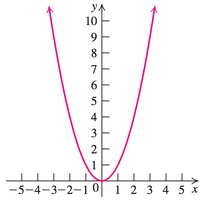
Squaring | Even (y-axis) | |||
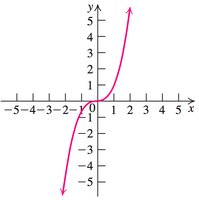
Cubing | Odd (origin) | |||
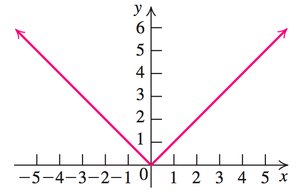
Absolute Value | Even (y-axis) | |||
Square Root | None | |||
Cube Root | Odd (origin) | |||
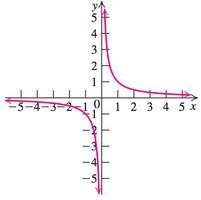
Reciprocal | Odd (origin) | |||
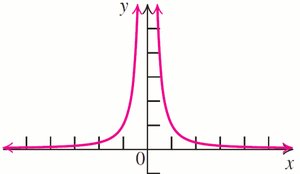
Reciprocal Square | Even (y-axis) | |||
Greatest Integer | Integers | None |
Graphs of Basic Functions
Identity Function:
Squaring Function:
Cubing Function:
Absolute Value Function:
Square Root Function:
Cube Root Function:
Reciprocal Function:
Reciprocal Square Function:
Greatest Integer Function:
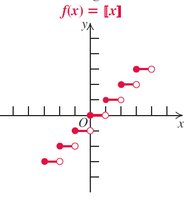
Additional info: Rational power functions and other variations can be constructed by combining these basic forms. Understanding their domains, ranges, and symmetries is crucial for graphing and analyzing more complex functions.
