 Back
Chapter 3: Radian Measure and the Unit Circle – Precalculus Study Notes
Study Guide - Smart Notes
 Tailored notes based on your materials, expanded with key definitions, examples, and context.
Radian Measure and the Unit Circle
3.1 Radian Measure
Understanding radian measure is fundamental in trigonometry and calculus. Radians provide a natural way to describe angles based on the properties of circles.
Radian: An angle with its vertex at the center of a circle that intercepts an arc equal in length to the radius of the circle has a measure of 1 radian.
General Formula: If a central angle θ (in radians) intercepts an arc of length s on a circle of radius r, then the radian measure is given by:
Unit Circle: The unit circle (radius 1) is used to define trigonometric functions for all real numbers.
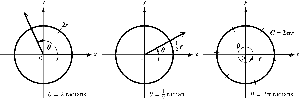
Conversions between Degrees and Radians
To convert degrees to radians, multiply by .
To convert radians to degrees, multiply by .
Example: Convert 45° to radians: radians.
Example: Convert radians to degrees: .
Agreement on Angle Measurement Units
If no unit is specified, angles are assumed to be in radians.
Degrees and radians are not interchangeable; always check the context.
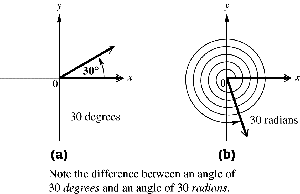
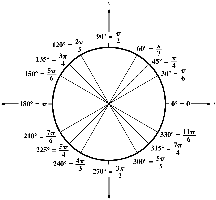
Equivalent Angle Measures
Common angles and their equivalents in degrees and radians:
Degrees | Radians (Exact) | Radians (Approximate) |
|---|---|---|
0° | 0 | 0 |
30° | 0.52 | |
45° | 0.79 | |
60° | 1.05 | |
90° | 1.57 | |
180° | 3.14 | |
270° | 4.71 | |
360° | 6.28 |
Trigonometric Function Values of Angles in Radians
Trigonometric functions can be evaluated for angles measured in radians using the unit circle.
Calculator must be in radian mode when working with radian measures.
3.2 Applications of Radian Measure
Radians are essential for solving real-world problems involving circles, such as arc length and area of a sector.
Arc Length on a Circle
The length s of an arc intercepted by a central angle θ (in radians) on a circle of radius r is:
θ must be in radians for this formula to be valid.
Example: Find the distance between two cities using latitude as the central angle and Earth's radius as r.
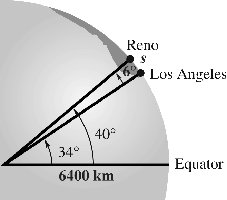
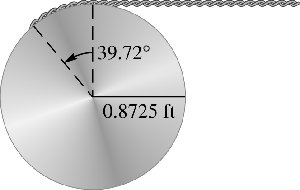
Example: Find the length of rope wound around a drum given the angle and radius.
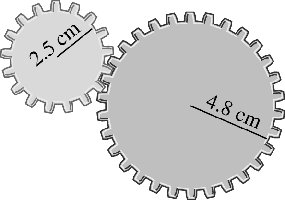
Example: Find the angle a larger gear rotates when driven by a smaller gear.
Area of a Sector of a Circle
A sector is the region bounded by two radii and the intercepted arc.
The area A of a sector with radius r and central angle θ (in radians) is:
θ must be in radians for this formula to be valid.
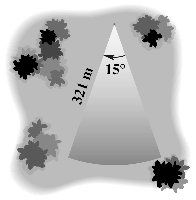
Example: Find the area of a sector-shaped field given the radius and angle.
3.3 The Unit Circle and Circular Functions
The unit circle is a powerful tool for defining and evaluating trigonometric functions for all real numbers.
Circular Functions
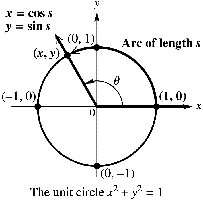
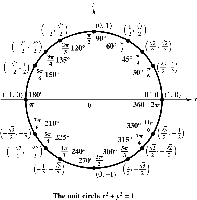
The unit circle has center at the origin and radius 1.
For a real number s, the coordinates (x, y) on the unit circle correspond to:
The equation of the unit circle is:
Values of the Circular Functions
Common values for sine and cosine can be found using the unit circle at standard angles (multiples of 30°, 45°, 60°, etc.).
Function Values as Lengths of Line Segments
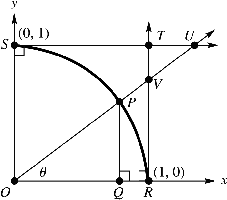
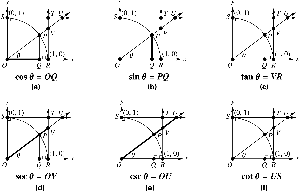
Trigonometric functions can be interpreted as lengths of line segments in the unit circle diagram.
This connects the right triangle definitions to the unit circle approach.
3.4 Linear and Angular Speed
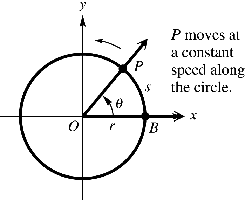
Linear and angular speed describe how quickly a point moves along a circle and how quickly the angle changes, respectively.
Linear Speed
Linear speed v is the rate at which the arc length s is traversed:
For a circle of radius r and angular speed ω (in radians per unit time):
Angular Speed
Angular speed ω is the rate at which the angle θ changes:
θ must be in radians for these formulas.
Example: Find the angular and linear speed of a pulley given its radius and revolutions per minute.
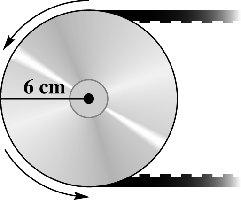
Example: Find the linear speed and distance traveled by a satellite in orbit.
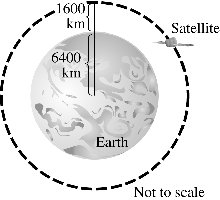
Summary Table: Linear and Angular Speed Formulas
Quantity | Formula | Units |
|---|---|---|
Arc Length | Length (e.g., cm, m) | |
Area of Sector | Area (e.g., cm2, m2) | |
Linear Speed | Length/time (e.g., m/s) | |
Angular Speed | Radians/time |
Reflect: Radian measure is based on the intrinsic properties of circles, making it the natural choice for calculus and advanced trigonometry. The unit circle unifies the definitions of trigonometric functions for all real numbers, and the concepts of linear and angular speed are essential for applications in physics and engineering.
